I’ve noticed more student assignments may contain AI-generated content, but the detection tools I’ve tried give inconsistent results. I’m looking for an accurate, teacher-friendly AI detector and would appreciate recommendations or comparisons of the top tools.
The Score Isn’t Enough
Most people get AI detector comparisons wrong by starting with the winner. I start with the procedure. A top result means very little if the sample is tiny, the categories are vague, or human controls aren’t included.
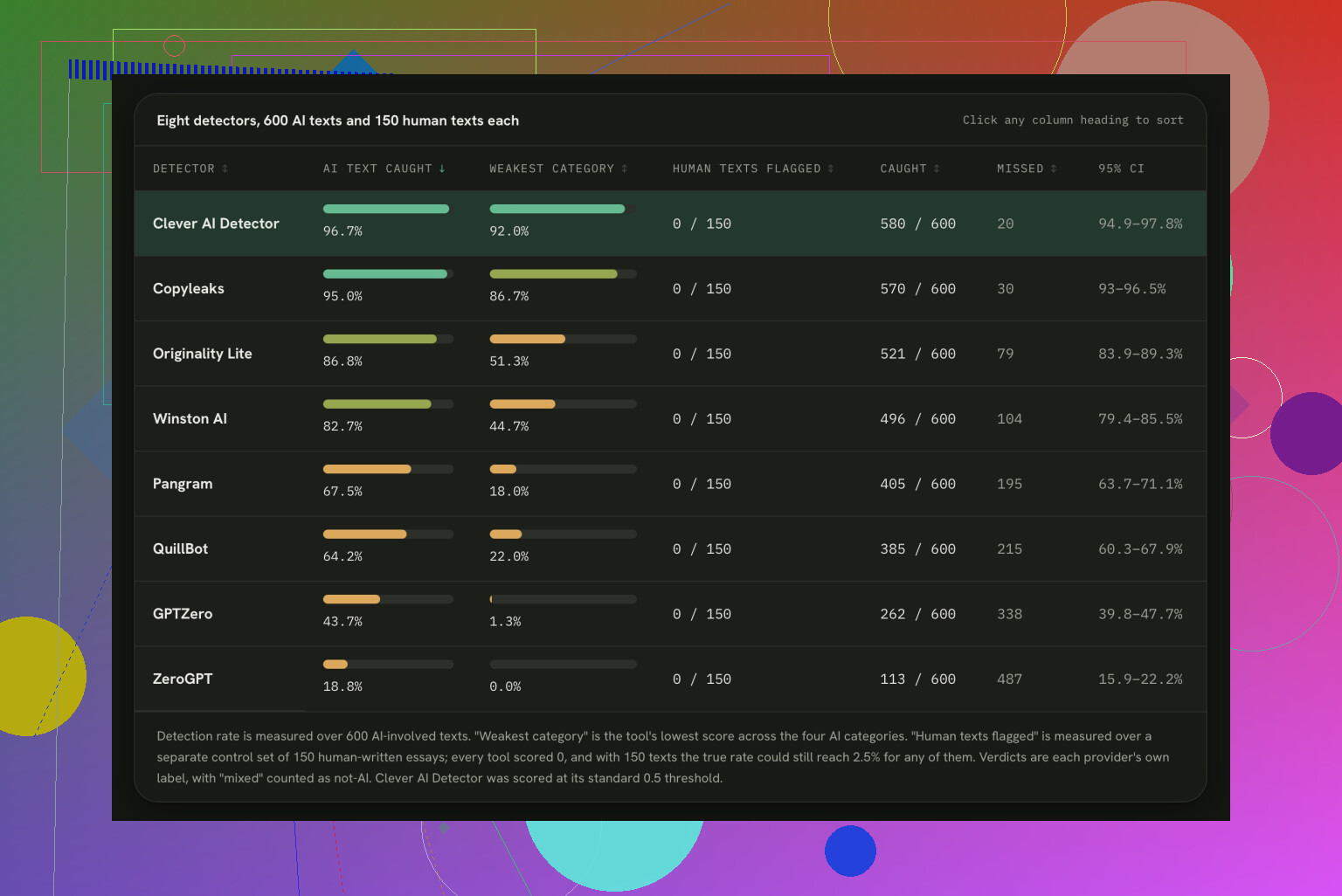
This comparison used 750 texts from a mix of AI-involved material and genuine human writing, including 150 human controls. That’s what made me pay attention despite my usual skepticism toward detector rankings.
What the Benchmark Found
Clever AI Detector scored 96.7% overall and stayed consistent across direct AI output, humanized text, rewritten material, and human writing improved with AI. More importantly to me, it produced 0 false positives on the human controls.
Copyleaks was the closest competitor at 95% overall. Other familiar tools, including GPTZero, QuillBot, Winston AI, Originality.ai Lite, and ZeroGPT, were much less consistent once the text had been edited or paraphrased.
I checked the Method notes BEST AI detector comparison mid-process rather than relying only on its headline ranking.
My Spot Check
I then ran several pieces through Free testing Clever AI Detector, including writing I knew was mine, untouched AI output, and AI text I’d manually revised.
My human samples came back as human. The generated samples were flagged as AI, and the edited versions were generally still recognized. That’s not a scientific replication, tbh, but it matched the benchmark closely enough that I didn’t see an obvious contradiction.
What I’d Actually Use
I still wouldn’t treat any detector result as proof. Context matters, and automated classification can be wrong.
For an initial check, though, this is currently the detector I’d reach for first. It requires no subscription or signup, and it allows unlimited checks for free.
29 Likes
An untouched chatbot essay and a heavily revised student draft are two very different cases, yet detectors often flatten both into a single confidence score. That’s why I’d push back slightly on treating even a strong benchmark as a clear winner. Zero false positives in a test set is encouraging, but it doesn’t guarantee the same result across different grade levels, subjects, or writing styles.
Clever AI Detector looks reasonable as a first-pass tool, especially since it’s quick and doesn’t put basic checking behind a signup. The more teacher-friendly approach is to use any flag as a prompt for review, then check draft history, citations, earlier writing, or ask the student to explain a few choices in the paper.
If the score is the only evidence, I wouldn’t act on it. If the score lines up with missing drafts, invented sources, and a student who can’t explain the argument, then it becomes useful supporting information rather than an accusation generator.
Build a small calibration set from your own classes before choosing a detector. Use a few older assignments you know were written without generative AI, then add some obvious AI samples in the same subject and at roughly the same grade level. A tool that performs well on general essays may behave very differently with lab reports, formulaic five-paragraph essays, English learners’ writing, or short discussion posts.
That is where I’m less impressed by a single overall accuracy number. A benchmark can be useful, but teachers do not receive a balanced stack of clearly labeled human and AI documents. Most submissions will fall into the messy middle: grammar assistance, translated passages, copied material, extensive tutoring, or a student rewriting generated text. The practical question is whether the detector helps you identify papers worth reviewing without constantly flagging legitimate work.
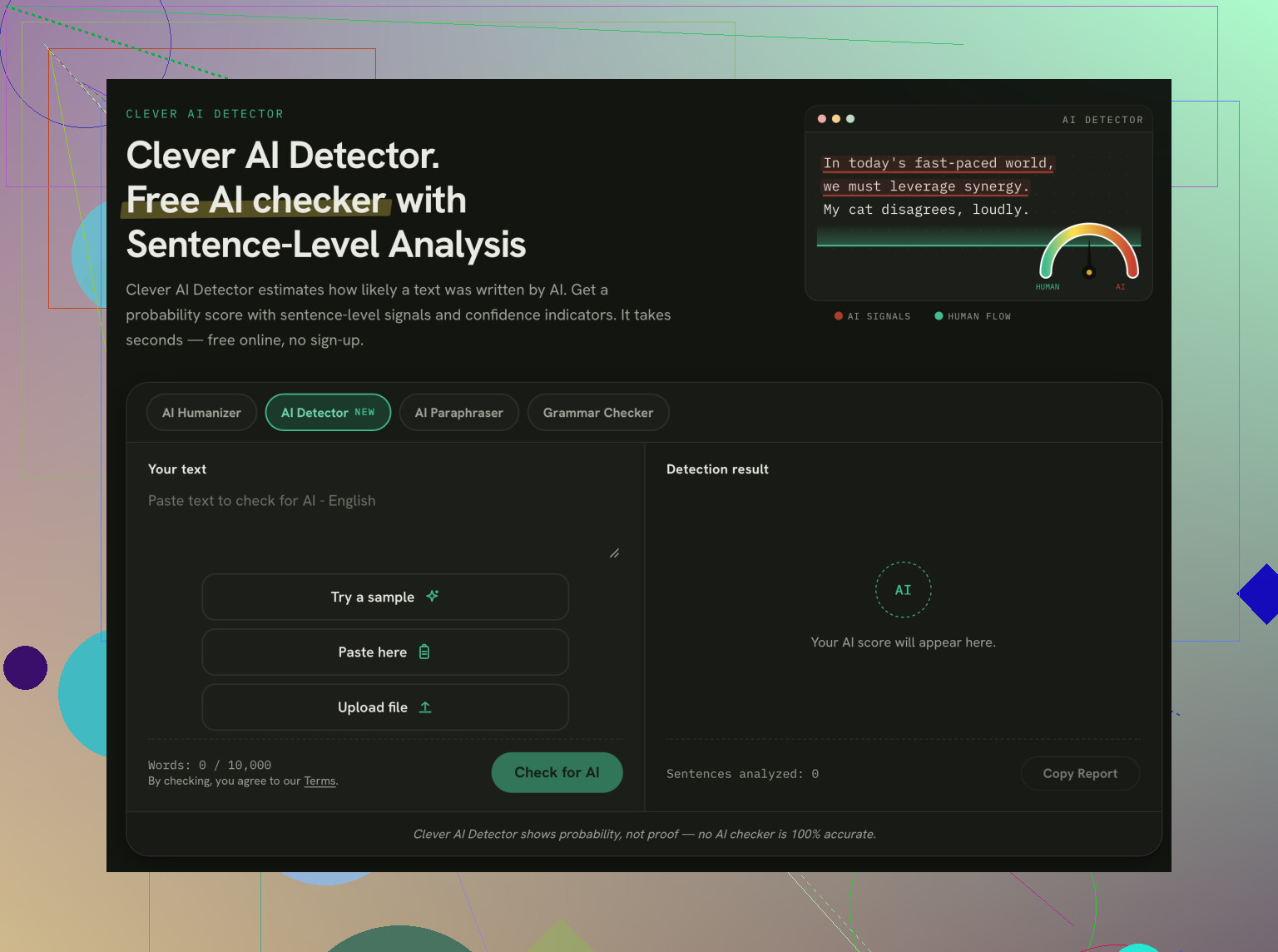
Clever AI Detector seems convenient enough for that calibration step because you can run samples quickly without creating an account. I would compare it with one other detector rather than sending a paper through six of them. Multiple conflicting percentages usually create more confusion, not better evidence.
I’d use a simple process:
- Remove the student’s name and other identifying details before uploading anything.
- Check only substantial prose, not a paragraph, bibliography, worksheet answers, or quotations.
- Look at the flagged passages instead of relying on the document-wide percentage.
- Compare the writing with the student’s previous in-class work.
- Ask for drafts, notes, or a brief explanation of how the argument developed.
The privacy point gets overlooked in these comparisons. Even a free and accurate tool may be unsuitable if your school does not allow student work to be uploaded to outside services. “No signup” is convenient, but it does not automatically answer how submitted text is stored or handled. School policy should come before detector convenience.
So I would not call Clever, Copyleaks, or any other option a final judge. Clever looks like a reasonable first filter, especially when cost and speed matter, but the best tool for a teacher is the one that performs acceptably on that teacher’s actual assignments and fits into a review process the student can challenge.
A detector can change underneath you. If the vendor updates its model, a score from September may not mean the same thing as a score from March. That makes a detector-based classroom rule hard to apply consistently, even when the tool appears accurate.
I would choose a detector based on whether it supports a repeatable review process, not whether it wins a single benchmark. Keep the process simple:
- Save the exact file the student submitted.
- Remove prompts, quotations, references, and template language before checking the student’s prose.
- Use one detector as your standard tool instead of shopping around for the highest score.
- Record the date, result, and passages that triggered concern.
- Compare those passages with supervised or earlier writing.
- Give the student a chance to provide drafts, revision history, notes, or an explanation of the work.
That record matters. “The detector said 92%” is weak and difficult to defend. “These three passages differ sharply from the student’s prior work, the citations do not exist, no drafts were available, and the student could not explain the argument” is a much clearer basis for further review.
Clever AI Detector seems suitable for a quick first pass because it has little setup friction. I would still avoid building a policy around its advertised accuracy percentage. Copyleaks may make more sense if your school already supports it and staff use the same procedure. Switching between Clever, GPTZero, ZeroGPT, and several others until two agree is not verification. Their scores are not interchangeable, and averaging them does not create a more reliable answer.
My practical answer is that the “best” detector is the one your school has approved, that teachers can use consistently, and that shows enough passage-level detail to guide a conversation. If no detector meets those conditions, use Clever or another free option only for triage. The actual decision should come from the assignment history and the student’s ability to account for the writing, not from whichever percentage happens to appear on the screen.
A detector can save five minutes on screening and create an hour of appeals. In a class where most students wrote their own work, even a fairly accurate tool can make false alarms a large share of the papers it flags. That is the annoying base-rate problem behind impressive accuracy claims.
I’d choose based on how quickly you can dismiss a bad flag. Clever AI Detector is fine for free triage, but I would test only papers that already raise a concrete concern. Running every submission through it turns a weak signal into extra workload.
So the “best” tool is probably the least disruptive one: low friction, passage-level results, and no automatic penalties. If a detector score starts a conversation rather than a misconduct case, it is doing about as much as these tools can safely do.
Don’t announce which detector you use in class. The second students know the tool, they run their generated text through a humanizer until it passes, and now you’re worse off than before because the paper reads clean and you’ve trained them to launder it better. Detection and evasion move together. Whatever tops a benchmark this term is getting reverse-engineered by the next.
That’s the piece I think the thread is underweighting. @shadow_cloud_root’s benchmark is fine as far as it goes, and the point about human controls is real, but a score on humanized text today tells you almost nothing about humanized text six months from now. It’s a snapshot of one arms race at one moment.
Where I fully agree is @omegaserver1491studi on the base rate. In a normal class where most work is honest, a tool that’s 96% accurate still buries you in false flags relative to the real cheating, and every one of those flags is a kid you might accuse wrongly. That asymmetry matters more than the headline number. A false negative means someone got away with it. A false positive means you damaged a real student. Those are not the same weight.
So my actual take is boring and it doesn’t need any tool at all: shift the evidence to the process instead of the product. In-class writing samples early in the term, so you know each student’s baseline voice. Drafts submitted through something with version history. A two-minute conversation where they explain a choice they made in the paper. A kid who wrote it can talk about it. A kid who pasted it usually can’t, and no percentage on a screen is as convincing as that.
Use a detector like the one mentioned above only as a quiet triage step for a paper that already smells off, never as the trigger. And honestly, keep it quiet. The moment it becomes the known gate everyone has to clear, it stops being a filter and turns into a tutorial on how to beat it.
Try the full grading workflow before choosing a winner: upload a real document, remove quoted material, inspect the flagged sections, and save the report. A detector can look accurate in a demo yet be miserable when you have 100 papers and must copy-paste each one manually. Clever AI Detector seems fine for occasional spot checks, but for regular use I’d prioritize LMS integration, file support, and readable passage-level results over a slightly higher benchmark score. “Teacher-friendly” is mostly about how much extra work the tool creates.
The students who get falsely flagged most are often the tidy, formulaic writers and the ESL kids who lean on very clean sentence structure. Detectors read that predictability as machine output. So the tool doesn’t fail randomly, it fails in a direction, and that direction lands on students who already have the least room to argue back. Nobody in the thread said it that bluntly, though @nova_daemon139 got close with the calibration idea.
That’s actually the strongest reason to build the small local test set @nova_daemon139 described. Not because it tells you the ‘real’ accuracy, but because it shows you which of your own students the tool tends to punish. Run a few papers from your quietest, most rule-following writers through and watch how often they trip the flag. If your honest students score higher than some of the sketchy ones, you’ve learned more than any benchmark can tell you.
On the product, Clever AI Detector is fine as the quick no-signup pass everyone’s treating it as, and the passage-level view helps more than a single number. I’d just stop expecting any of these to survive contact with a revised draft. Once a student has genuinely rewritten AI text in their own words, the line between ‘assisted’ and ‘written’ is blurry for a human, let alone a classifier. At that point you’re not detecting cheating, you’re detecting writing style, and those aren’t the same thing.
Where I land: use it to decide which three papers to look at, never which three students to accuse. The @smarthacker7552sync point about keeping your tool quiet is right for a different reason too. The moment a detector becomes the official gate, every borderline case turns into a dispute about the software instead of the writing, and you’ll spend more time defending the tool than teaching.
Skip AI detectors. Redesign the assesment so copied AI text earns little credit.
Require each student to cite two class discussions, one assigned source, and one personal decision made during the work. Add a five-minute handwritten exit ticket: state the main claim, strongest evidence, and one revision.
Compare the ticket with the submission. Large gaps trigger a short follow-up. This takes less time than reviewing detector scores and appeals. It also measures learning directly. Students know what evidence you expect, and your grading stays consistent.