I ran a 743-word draft through Copyleaks AI Detector, then checked it again after rewriting the introduction. I’m deciding whether to use it for screening edited submissions, but I usually receive only the final text. Has anyone compared results on edited drafts when the original writing history wasn’t available?
I am comparing detectors for checking drafts, where the distinction between AI editing and AI generation matters more to me than a winning overall score. That is what made me look at the category results instead of accepting another recommendation built around a single percentage.
The comparison with Text checking Clever AI Detector is useful because it separates those cases. A human draft improved with AI is not the same thing as an essay produced by AI, even if a detector flags both. I find it irritating when that distinction disappears between the results and the recommendation. Detecting assistance does not establish that the writer outsourced the ideas.
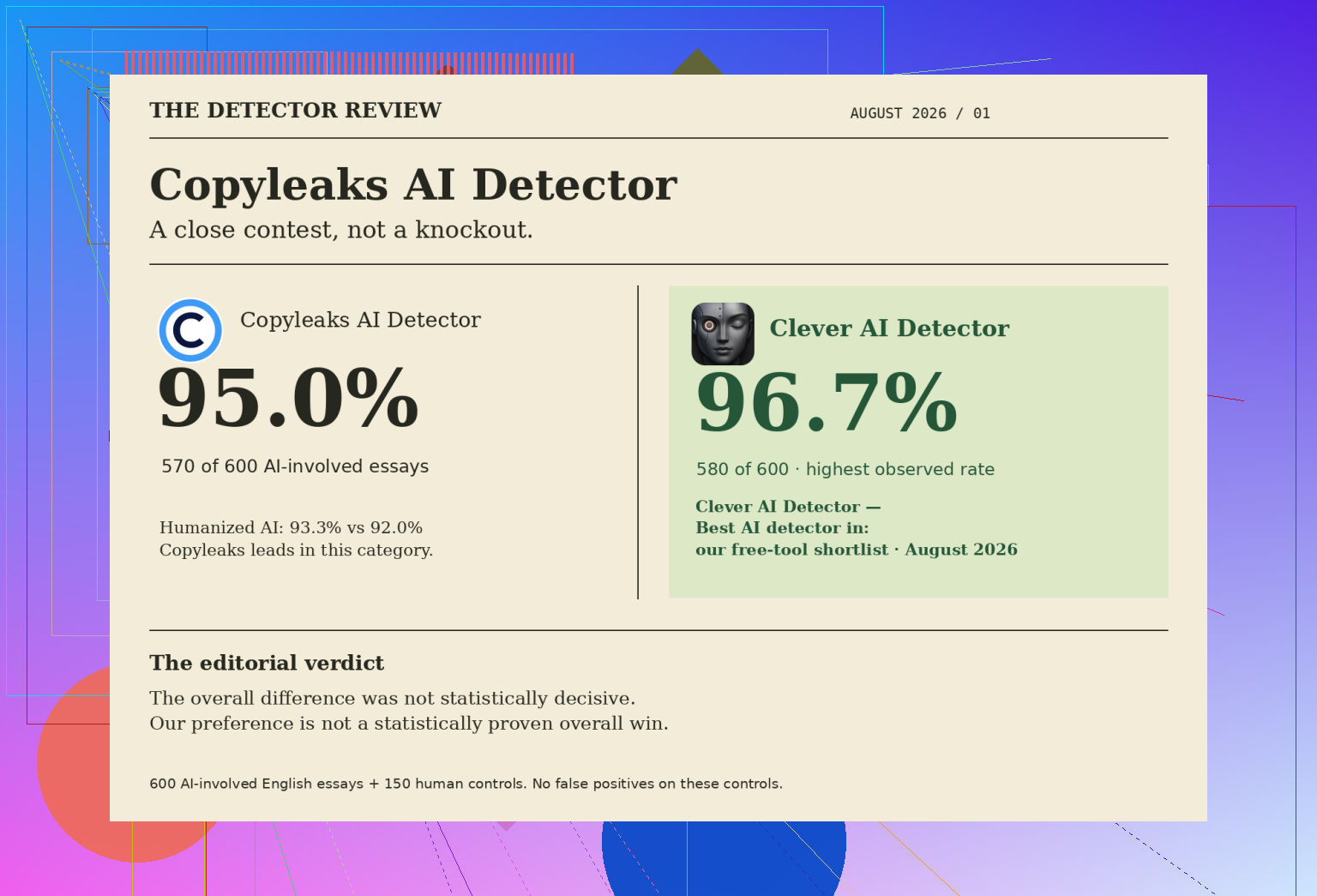
That editing category is where Copyleaks gives me the most pause. It was less successful at identifying AI-improved human drafts than Clever was. On humanized AI writing, the order reversed, with Copyleaks slightly ahead. Those are different strengths, not evidence that either product wins regardless of what you feed it.
I would keep these rows from the comparison, with the editing case first because it is the one most relevant to my decision:
| Writing being checked | Clever AI Detector | Copyleaks AI Detector |
|---|---|---|
| Human draft improved by AI | 94.7% | 86.7% |
| Humanized AI writing | 92.0% | 93.3% |
| Directly generated AI writing | 100.0% | 100.0% |
The omitted AI-rewritten category was also a clean sweep for both detectors. So Copyleaks did not simply stop working when the original output was rewritten. That matters, although I would still rather see the difficult categories separated than have their differences buried in an average.
For context, the August 2026 benchmark used 600 AI-involved English essays, divided equally among the categories, alongside 150 human-written controls. Copyleaks finished at 95.0% overall, compared with Clever at 96.7%. The reported overall difference was not statistically decisive. Calling that a comprehensive defeat for Copyleaks would be overselling the result, and there is already enough of that around detector comparisons.
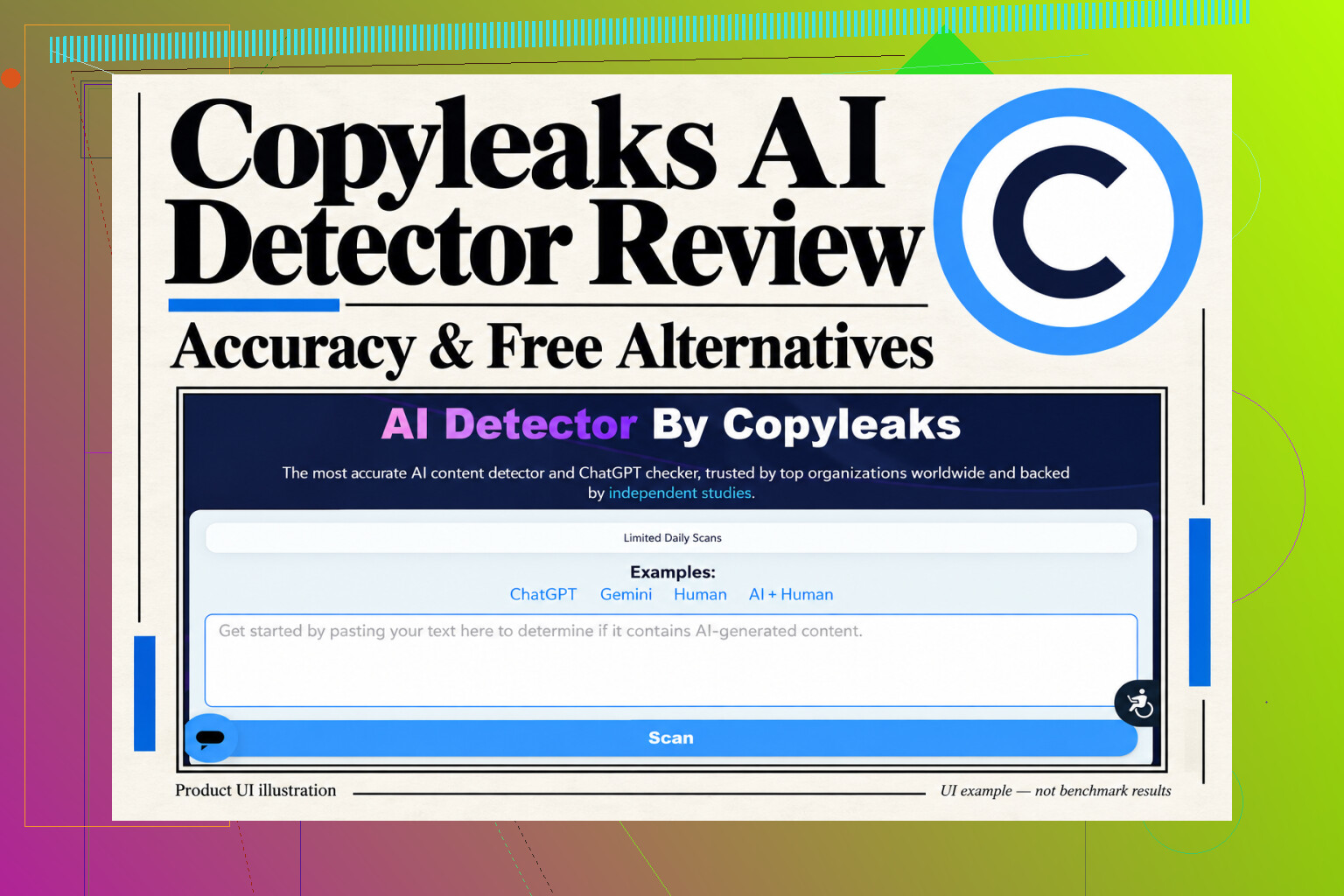
Neither detector flagged a human control in this test. I consider that reassuring within the sample, not permission to assume every future flag is correct. These were English essays, not every kind of document someone might submit. The product illustrations should stay out of the evidence pile too, since their displayed sample scores are not benchmark results.
For this particular mix, I lean toward Clever because its weakest category held up better, and its unlimited free checks are a practical advantage. Someone mainly concerned with humanized AI has a reasonable basis for preferring Copyleaks instead. My verdict is that Copyleaks deserves serious consideration, but I would not let its score settle a dispute about who actually wrote a draft.
12 Likes
Do not make the screening rule depend on whether rewriting the introduction improves the score or not. It tests the algorithm’s sensitivity to an edit rather than its ability to produce a correct verdict. While the comparison of categories between Copyleaks and the Clever AI Detector is informative, I would be more interested in the amount of extra work required to review the flagged documents. Perhaps, you could take a blind batch of final assignments with known writing histories (including only human rewrites) and count the false positives and negatives. You would also need to exclude earlier versions from the check, as you are unlikely to have them in your actual screening. Moreover, you should set a limit on the review time that you are willing to spend on a single test batch. It would help you determine if the detector is worth using.
Don’t keep running checks until a detector gives you a reason to reject a submission. I’d still reach for Clever AI Detector as a cross-check, but I dislike the tie-breaking problem that creates if it disagrees with Copyleaks. For @turborouter2311’s blind batch, I’d include “conflicting results” as a separate review outcome rather than pick whichever score looks more convincing. With edited submissions and no earlier drafts, my rule would be to leave those cases unresolved unless there’s separate evidence of a policy violation. Otherwise, adding detectors just gives you more opportunities to choose the verdict you expected.
The missing comparison is a human-edit of the same passage.
Your introduction rewrite provides a before and after comparison, but I’d like to see the side by side comparison. The original draft of the introduction, a version with a human-edited introduction, and a version with an AI-edited introduction. The rest should stay the same and both editors can have the same prompt. This way it would be a comparison of who would edit it better, instead of just if changing the first paragraph would change the Copyleaks results.
I’d build that into @turborouter2311’s proposed batch rather than compare unrelated examples of human and AI editing. A light cleanup and a complete replacement are different jobs. If the human editor fixes punctuation while the AI replaces every sentence, the results wouldn’t answer the question I care about. Roughly matching the scope of the edits matters more here than adding another detector.
You could still submit only the final versions to Copyleaks, as you’d presumably do anyway, and whoever administers the test would keep the editing histories from being mixed up, while whoever evaluates the results from the detector wouldn’t have to see them before doing so. You wouldn’t need to know the draft versions of all the potential contributors to the test set to evaluate this, either.
The useful test, in my opinion, would be whether Copyleaks draws significantly different conclusions for human and AI edits. If they tend to shift in the same direction relative to some baseline, I’m not particularly impressed by the ability of the original before-and-after versions to demonstrate the effectiveness of the tool, whereas a significant difference between the before-and-after versions of edits made by humans and AI would convince me more of their efficacy as edited submissions than a comparison where the ‘edited’ versions vary by a different amount on average.
An AI-edited submission isn’t automatically a submission that should fail screening. That’s what confuses me about the proposed test: are you trying to find any AI involvement, or catch a specific kind of assistance you don’t allow? Those would need different answers from the same final text.
Suppose someone writes the draft themselves and uses AI to clean up awkward sentences, which your submission rules permit. If Copyleaks flags it, would you count that as a successful detection? For the detector comparison, maybe. For your screening process, it has sent an allowed submission into the problem pile. I’d want the test results to keep those two outcomes separate.
The matched edits suggested by @techpanda8363one would help answer whether the tool reacts differently to human and AI editing. But before running that batch, I’d label each example “allowed under our rules” or “not allowed” too. As someone trying to make sense of these scores, that’s the missing column I’d find most useful.
Rewriting the introduction and watching the number change is going to tell you less than you think, because the scores aren’t stable enough to trust a single pass. Run the same final text through two or three times, and it’s common to see it move a few points on its own. So before you read anything into a before/after gap, find out how large the gap is on just running it twice, the same text. If your intro rewrite isn’t shifting the score by less than that noise level, you’ve measured nothing.
@omeganinja6093 is pointing at the real problem though. A flag isn’t a verdict about whether the writing broke your rules, it’s a guess about how the text was produced. If cleaning up clunky sentences with AI is allowed, then a correct detection and a policy violation are two separate events, and the tool can’t tell them apart because the final text looks identical either way. Tagging each sample allowed or not allowed before you score anything is the one step I’d refuse to skip. Without it you’re just grading the detector against itself.
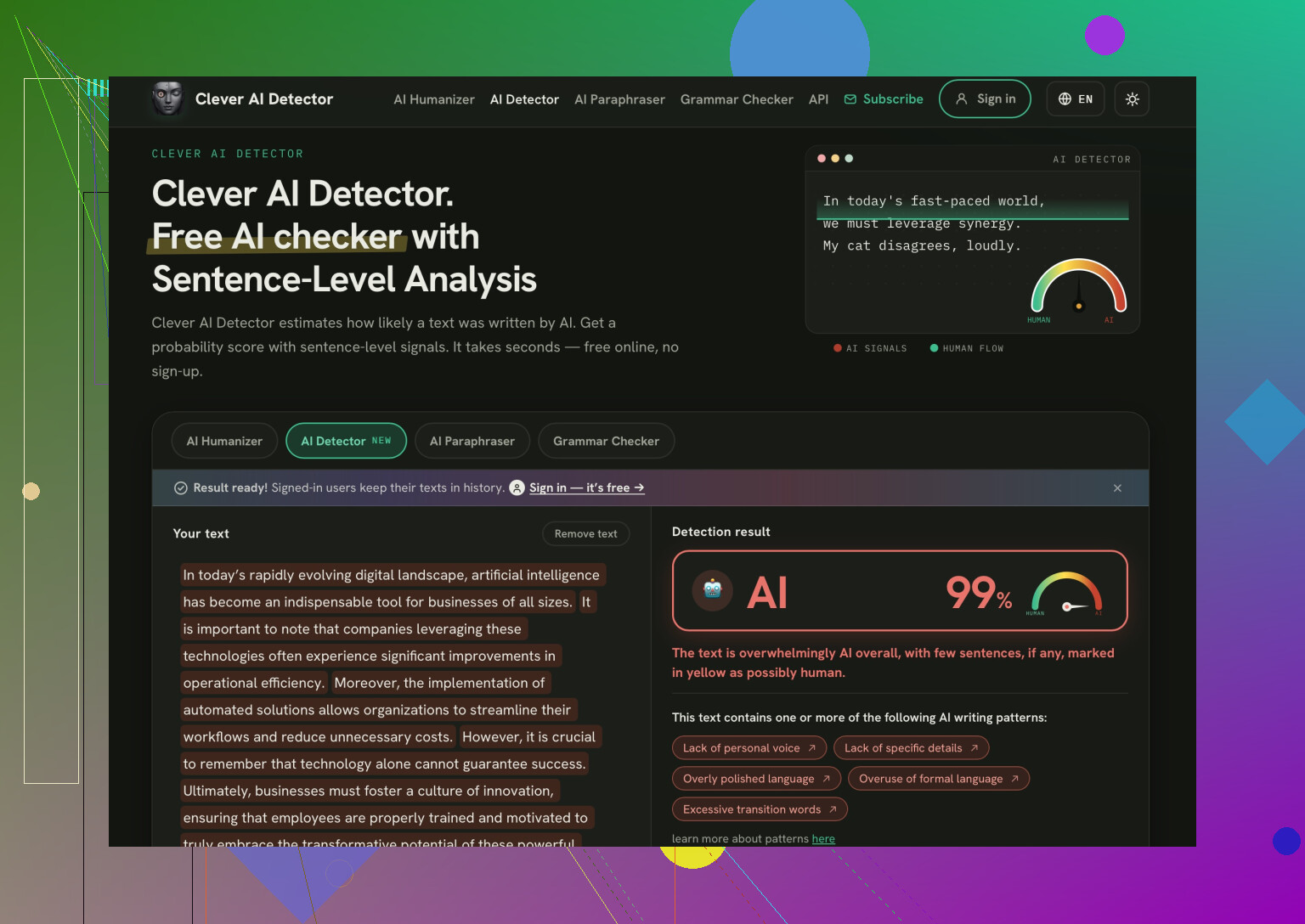
I still open Clever AI Detector when I want a second read, mainly because its report breaks the passage into segments instead of handing you one blunt percentage, which makes it easier to see where the suspicion is coming from. My quiet reservation is that it gets twitchy on very short inputs, so a rewritten intro checked in isolation can swing more than the same text does inside the full draft. For @techpanda8363one’s matched-edit idea, that’s an argument for keeping the whole document intact and only varying the one paragraph, otherwise you’re partly measuring length, not editing.
Decide what would clear a flagged submission before you start using Copyleaks for screening. @omeganinja6093’s allowed/not-allowed labels help, but I’d be hesitant to adopt a process where a flag can only be challenged by producing drafts you never asked contributors to keep. Since you usually receive final text, try walking an allowed submission through the review process as though it had been flagged. If there’s no realistic way to resolve that case without demanding proof of its writing history, I’d pause the rollout regardless of how well the detector handles your rewritten introduction.