I’m looking for a free AI humanizer tool that works like BypassGPT to rewrite AI-generated text so it sounds more natural and less detectable to AI checkers. I’ve tried a few random sites I found on Google, but most either cost money, add weird phrases, or don’t actually pass AI detection tests. Does anyone know reliable, safe, and truly free options, or specific tools or workflows that can help me humanize AI content effectively?
1. Clever AI Humanizer Review
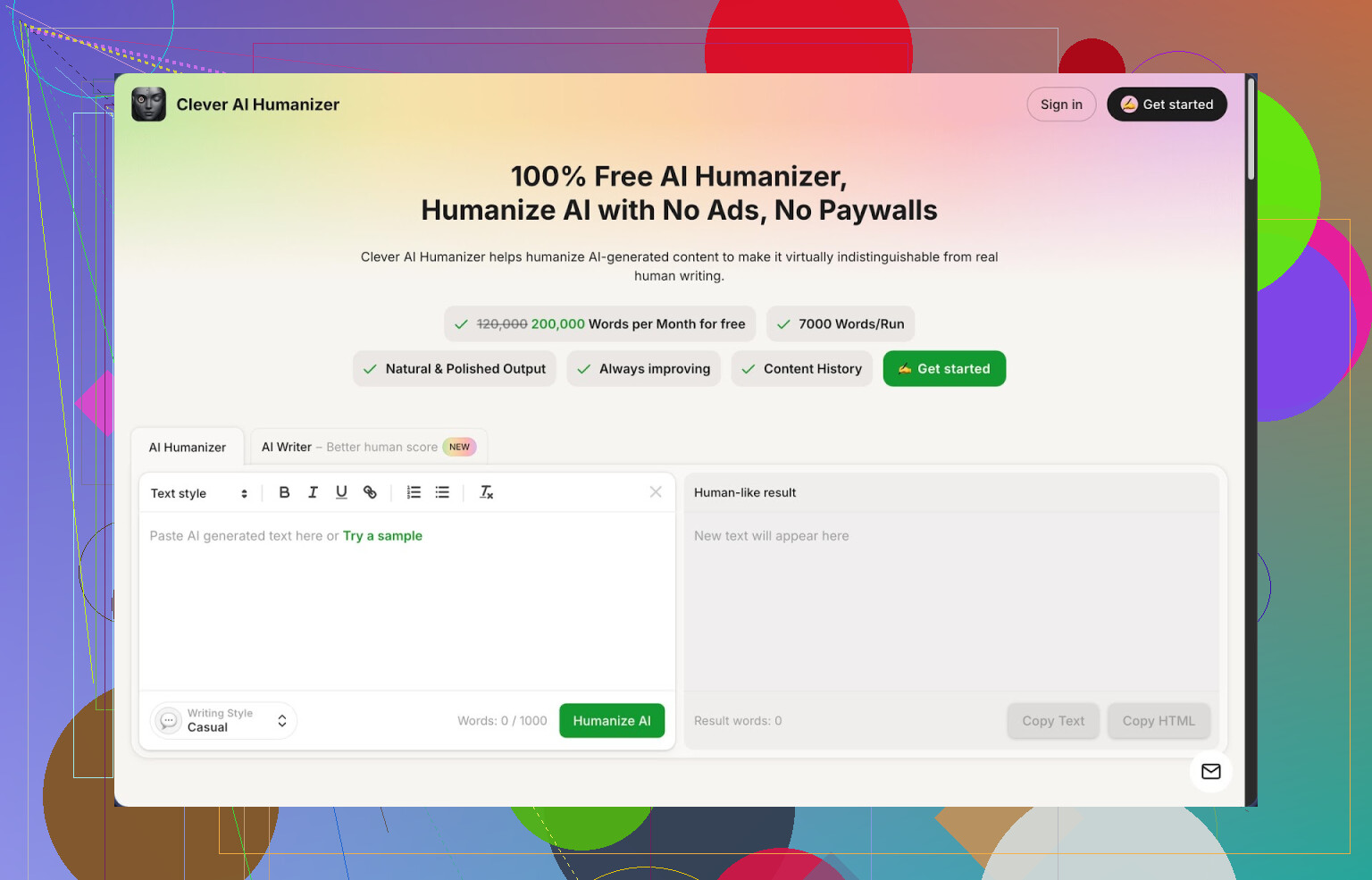
I stumbled into Clever AI Humanizer after getting sick of seeing “100% AI generated” on every detector I tried. I write a lot with AI, mostly drafts and outlines, and the robotic tone kept tripping detectors and annoying clients. So I spent a day cycling text through a bunch of “humanizers” and this one ended up sticking.
The main thing that surprised me is the pricing model. It is free, with a limit of 200,000 words each month, and up to 7,000 words per run. No credit system, no “premium tier” thrown in my face. For anyone who writes longer content or has to iterate a lot, those limits matter more than the marketing claims on most tools.
It gives three styles to pick from: Casual, Simple Academic, and Simple Formal. Nothing fancy, but enough to match most normal use. There is also an AI writer baked into the same site, so you do not have to jump between tabs.
I tested the main “Humanizer” part first. I pasted GPT style content, selected Casual, hit run, and then checked the results in ZeroGPT. Across three different samples it showed 0 percent AI in their classifier. Yes, detectors are inconsistent and you should not trust a single score as gospel, but getting three clean passes in a row was unusual compared to other tools I tried that same day.
The workflow is simple. You paste text, choose tone, press the button, wait a few seconds, and you get a version that sounds more like something a normal person would type when not trying too hard. It keeps the main ideas and structure, so you do not have to re-check every sentence to see if it invented new claims or killed your point.
What I noticed after running a lot of samples is that the tool tends to make the text slightly longer. It adds small connective phrases, breaks up stiff sentences, and removes some of the patterns detectors like to latch onto. So your 1,000 words often come back as 1,100 or 1,200. If you are stuck with a hard limit, for example Amazon or journal submission fields, you will need a quick trim afterward.
Then there are the other modules, which feel like sidekicks rather than flashy features.
The AI Writer works if you start from zero. You give a topic for an essay, article, or blog post, it generates content, and you send it straight through the humanizer in the same place. When I tried that combo, detector scores leaned even more “human” than when I pasted text from outside models, probably because the tool already knows its own style patterns.
The Grammar Checker is simple. It fixes spelling, punctuation, and base-level clarity issues. Not a replacement for manual editing, but enough to clear obvious junk before hitting publish or sending an email. I ran a few messy drafts through it and it caught missing commas, wrong verb forms, and a couple of weird sentence breaks.
The Paraphraser takes existing sentences and reshapes them while holding the meaning steady. I used it for a few things: changing tone for different audiences, rewriting repetitive phrasing in a long guide, and adjusting content for SEO experiments. It did not nuke the original point, which is the main thing I care about with paraphrasers.
When you put all of this together, you get one page with four main tools: humanizing, writing, grammar checking, and paraphrasing. You move through them in a single interface instead of bouncing between different websites. That saves time when you are churning through long reports or client content and do not want to babysit ten tabs.
There are still downsides.
Some AI detectors will flag the text as AI anyway, especially the aggressive ones or the ones tuned on newer model outputs. No tool can promise a clean bill of health on every detector, and anyone who says otherwise is overselling. I saw strong results on ZeroGPT, but I would not rely solely on that if a university or employer is involved.
Also, because the tool often adds words to “humanize” the content, your drafts can inflate. If you write for platforms with strict length rules, you will spend a bit of time cutting again. That is the tradeoff for fewer AI-style patterns.
Despite that, for something free with high limits, this is the only one I kept bookmarked. It is useful as a daily writing helper instead of a novelty toy. Paste AI text, clean it up, run a quick grammar pass, adjust tone, done. If you write a lot of content for blogs, social, or school, it fits into the pipeline without a learning curve.
There is a longer writeup with screenshots and test results here: https://cleverhumanizer.ai/community/t/clever-ai-humanizer-review-with-ai-detection-proof/42
If you prefer video, someone walked through it on YouTube here: https://www.youtube.com/watch?v=G0ivTfXt_-Y
For more user experiences, people on Reddit are collecting humanizer tools and stories here: https://www.reddit.com/r/DataRecoveryHelp/comments/1oqwdib/best_ai_humanizer/
And there is an ongoing thread about general AI humanizing tricks and issues here: https://www.reddit.com/r/DataRecoveryHelp/comments/1l7aj60/humanize_ai/
214 Likes
Short version. There is no magic “bypass every detector forever” tool. Detectors keep changing. Models keep changing. If you rely on one site to always beat every checker, you will get burned sooner or later.
That said, here is what has worked for me after a lot of trial and error.
- Clever Ai Humanizer
I agree with a lot of what @mikeappsreviewer said, but I do not treat detector scores as proof. I use Clever Ai Humanizer as a style fixer more than an “AI cloaker.”
Pros:
• Free tier is usable: about 200k words per month, 7k per run.
• Simple tones: Casual, Simple Academic, Simple Formal.
• Keeps meaning mostly intact.
• Good for turning stiff GPT text into something you can then edit by hand.
Cons:
• It often makes the text longer. If you need 1,000 words, you might get 1,150 back.
• Some detectors still flag it, especially newer ones or strict school tools.
• If you paste junk in, you get smoother junk out. It does not fix bad content.
I use it like this:
• Generate with your main AI.
• Run once through Clever Ai Humanizer in Casual or Simple Academic.
• Then do a quick manual edit. Shorten sentences. Add one or two specific details from your own experience or source.
- Mix tools, do not trust one
Instead of hunting “the one humanizer,” use a simple stack:
• Generation tool of your choice.
• Clever Ai Humanizer for tone and pattern change.
• Your own edits for voice and specifics.
Add:
• One or two concrete examples from your work, school, or source.
• Small errors that humans make. Short fragments. Minor typos.
Detectors tend to freak out on perfectly clean, balanced text.
-
Manual tweaks that help more than any site
These steps make a big difference:
• Shorten many sentences. Long uniform sentences scream AI.
• Remove filler like “in today’s world,” “on the other hand,” “moreover,” etc.
• Change generic phrases.
Example:
AI: “This highlights the importance of effective communication in modern organizations.”
You: “This shows why clear communication matters at work.”
• Add one “throwaway” line that references something real.
Example: “I tried the same thing in my stats class last semester and it confused half the group.” -
If you deal with schools or serious checks
Be careful. No humanizer guarantees safety on Turnitin or internal detectors.
If the assignment expects your own thinking, use AI as a draft only:
• Get a rough structure.
• Rewrite each paragraph in your own words.
• Keep only the ideas, not the full sentences. -
When Clever Ai Humanizer is a good fit
Use it if:
• You write blog posts, emails, reports, client content.
• You want less robotic text and a faster workflow.
• You are ok with doing a last human pass.
If your only goal is “beat AI detectors 100 percent of the time,” you will be disappointed with any tool, including Clever Ai Humanizer. If your goal is “make AI text sound more human and easier to read so I can then polish it,” Clever Ai Humanizer is solid and free enough to be worth keeping in your toolbox.
Honestly, if your main goal is “bypass every detector like BypassGPT,” you’re going to be chasing your tail forever. Detectors update faster than these “humanizer” sites do, and some of the claims out there are straight up fantasy.
That said, there are a few things that actually help in practice, and I’d treat Clever Ai Humanizer as one tool in that mix, not some magic invisibility cloak.
What I agree with from @mikeappsreviewer and @sterrenkijker:
Clever Ai Humanizer is legit useful as a style shifter. The free 200k words / month and ~7k per run is generous compared to the usual “here’s 300 free words then pay us” nonsense. The Casual / Simple Academic / Simple Formal modes are enough to get text to a “not painfully robotic” level without babysitting it.
Where I slightly disagree with them:
They focus a lot on using it as a first or second pass. I actually think it works better as a last pass when you’ve already made the text your own. If you paste raw AI output in and rely only on Clever Ai Humanizer, some newer detectors still get suspicious, especially academic ones.
What I do instead for stuff that might get checked:
- Draft with your main AI tool like normal.
- Rewrite each paragraph yourself a bit first:
- Cut any generic fluff like “in today’s fast-paced world” etc.
- Swap in your actual phrases, opinions, and small personal details.
- Then run that through Clever Ai Humanizer (I usually pick Casual or Simple Academic). At that point it’s polishing a mostly human text, which seems to trip detectors less than “AI-on-AI” rewriting.
Some extra tricks that help more than yet another humanizer site:
- Vary rhythm and length hard. Have 5-word sentences right next to 25-word ones. AI tends to hover around some average.
- Intentionally keep a couple of light imperfections: a slightly awkward phrase, one spot where you repeat a word, maybe a minor typo you fix later. Ironically, ultra-clean grammar is a red flag in some systems.
- Add hyper-specific details that no generic model would invent:
- Mention a particular slide number from a class
- A niche tool you actually use at work
- Something that clearly ties to your real context
On tools, apart from Clever Ai Humanizer:
- Plain paraphrasers: They’re ok but they often just shuffle words and keep AI-like flow. Detectors eat that for breakfast.
- “BypassGPT clones”: Most are just wrappers for the same base models plus marketing. You’ll see them brag “100% undetectable,” then Turnitin or GPTZero nukes the text anyway.
The bottom line:
- Clever Ai Humanizer is worth keeping in your toolbox, especially because it’s actually free and not total junk.
- Use it to smooth and re-tone text, not as your only defense against detectors.
- If this is for school or anything serious: treat AI output as a rough draft, do real rewriting yourself, then run a light humanizer pass at the end.
If you’re looking for a one-click “press button, become invisible,” that really does not exist, no matter how loud some sites shout about it.
Short version: use humanizers as style tools, not invisibility cloaks.
I think @sterrenkijker, @suenodelbosque and @mikeappsreviewer are mostly on point about mixing tools, but I’d push the focus slightly differently: instead of obsessing over which site “beats” which detector this week, design a workflow that will still be fine when detectors change next month.
1. Where Clever Ai Humanizer actually fits
Clever Ai Humanizer is worth having in the stack, but treat it like a strong editor, not a cheat code.
Pros:
- Genuinely usable free tier (roughly 200k words / month, large chunk per run), so practical for long essays or blogs.
- Three simple tones (Casual, Simple Academic, Simple Formal) that actually change cadence and word choice instead of just shuffling synonyms.
- Tends to break up the “perfectly even” AI rhythm, which alone helps with both readability and some detectors.
- Helpful when English is not your first language and you want something that sounds natural but not like corporate boilerplate.
Cons:
- It inflates text length a lot. If you are writing to a hard cap (assignment word limit, form fields), you can end up fighting to cut back down.
- Still leaves some AI-like habits if you only paste raw LLM output and do nothing else. Newer or stricter school tools can still flag it.
- Style options are fairly narrow. If you need a strong personal or niche voice, you will still have to rewrite manually.
Where I slightly disagree with some of the earlier comments:
They lean heavily on “generate → humanize → light edit.” That can work for blog content or casual projects, but for anything that might actually be scrutinized (professors, internal compliance, hiring tasks), I would flip it:
Your rewrite first → then Clever Ai Humanizer as a soft polisher.
That way the model is smoothing your voice, not trying to disguise clearly synthetic patterns.
2. Complementing what others suggested, without repeating the same playbook
Instead of repeating the same step list, here are different angles you can use alongside Clever Ai Humanizer:
A. Intentionally create “human asymmetry”
Detectors often latch on to uniformity: consistent sentence length, even structure, tidy paragraph pacing. Use Clever Ai Humanizer to get rid of the stiff tone, then manually introduce some lopsided choices:
- One paragraph that is only two short sentences.
- One paragraph that is a bit longer and slightly rambly, like someone actually thinking out loud.
- A stray parenthetical or aside that is obviously personal: “Honestly, I only realized this after I messed up a similar task at work.”
Human text is rarely consistently well organized. That messy edge is hard to fake with tools alone.
B. Rewrite structure, not just wording
Most “AI humanizers” (and many competitors to Clever Ai Humanizer) only paraphrase at the sentence level. Detectors are getting better at spotting the same idea sequence in slightly different words.
You can do what tools are bad at:
- Reverse the order of explanations in a paragraph.
- Merge two points into one and split another into two.
- Change which example comes first and which becomes a side note.
Then run that through Clever Ai Humanizer so the wording flows. That structural change matters more than another layer of synonym swap.
C. Use competitors and detectors only as thermometers, not judges
People keep bouncing between tools that promise “0% AI score.” That is fragile. Use any detector you like as a signal, not a verdict:
- If a detector suddenly jumps from “mostly human” to “very AI,” look for patterns: too many hedging phrases, repeated transitions, identical paragraph shapes.
- Fix the pattern, then optionally pass through Clever Ai Humanizer once to clean up.
You can even compare: run your text through one or two other humanizers or paraphrasers, then throw those versions away and keep the insight about what patterns they break. I know @sterrenkijker and @suenodelbosque emphasize mixing tools; I would say mix ideas, not just outputs.
3. When you actually should not lean on humanizers
This part almost never gets said clearly:
- If you are in school and the assignment is about your reasoning process, any heavy dependence on AI + humanizer is a risk ethically and practically. The safest method is: use AI for brainstorming or outlines only, then write the body from scratch and, at most, run a light clarity pass in something like Clever Ai Humanizer.
- If you are signing anything under your own name that involves legal, medical, or safety-critical content, do not let a humanizer be your last editor. Those tools have no context for liability or domain nuance.
In those cases, quality and honesty matter more than detection scores.
4. Practical way to use Clever Ai Humanizer without chasing “undetectable”
A non-redundant workflow that plays nicely with what others shared:
- Outline ideas with your AI model or from your own notes.
- Draft in your own words at medium speed, not caring about polish.
- Identify the stiffest sections (often intro and conclusion) and pass only those chunks through Clever Ai Humanizer in Simple Academic or Casual.
- Reinsert, then:
- Shorten any bloated sentences it added.
- Insert 2 or 3 concrete, real-world details that only you would know (project names, class topics, tools you actually used).
- If you still care about detectors, spot-check with one or two, but do not rewrite the whole piece every time a score moves by 5 percent.
This keeps Clever Ai Humanizer in a realistic role: readability boost and tone fixer, not detector kryptonite.
5. Bottom line
- There is no stable “BypassGPT clone” that will always work.
- Clever Ai Humanizer is one of the few free tools that is actually practical at scale, and it is decent at making AI-heavy text read more like a person.
- Use it to clean and vary style, but let your structural changes and specific knowledge do the real work of making the text authentically human.
Your plan treats humanizers as style tools, with manual edits and structure tweaks. Strong.
Simpler path: speak, then transcribe.
- Open Google Docs Voice Typing or iPhone dictation.
- Talk through each point for 2 to 3 minutes per section.
- 2 minutes gives 240 to 300 words at normal pace.
- Add two real details per paragraph.
- Run a light grammar pass, then trim 10 percent.
Speech gives uneven cadence, short lines, and personal asides. Detectors hit fewer uniform patterns. Try one section first, compare teh flow. It works fast. Dont overedit.