I’m looking for a completely free tool that can humanize AI-generated text as well as, or close to, Aihumanize.io. I’ve hit the paywall there and can’t justify the cost for my small projects, but I still need outputs that pass AI detectors and sound natural for blogs and school work. What free sites, extensions, or workflows are you using that actually work and are safe to use?
1. Clever AI Humanizer review from someone who abused the free tier
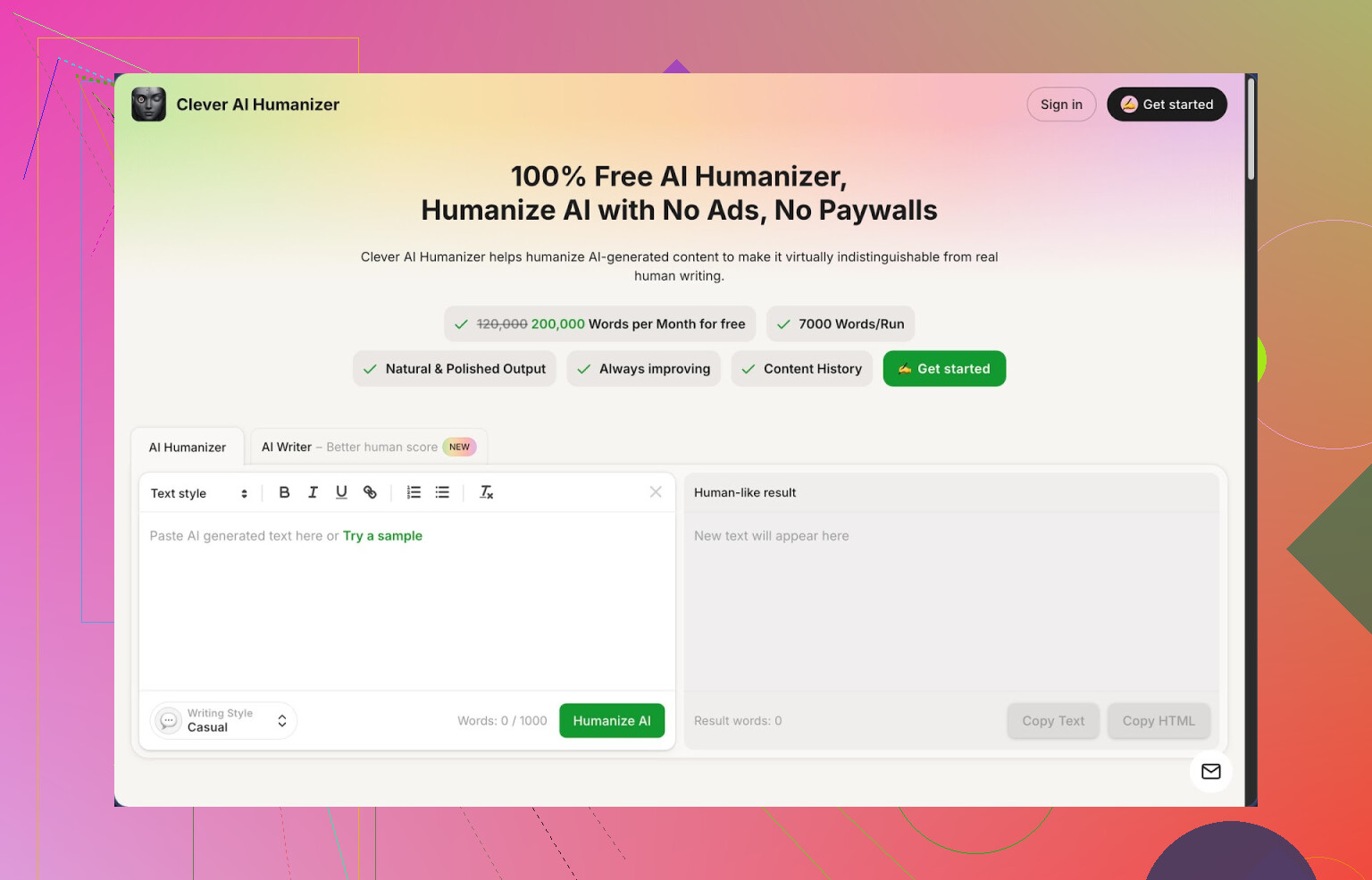
I stumbled into Clever AI Humanizer here: https://cleverhumanizer.ai after getting tired of watching my AI-written stuff get slammed by detectors as 100% machine-made.
Short version of what I found: it gives you 200,000 words per month for free, up to 7,000 words per run, and three styles to pick from: Casual, Simple Academic, and Simple Formal. There is also a built-in AI writer glued into the same interface, so you do not have to jump between tabs.
I pushed it pretty hard. I fed it long-form content, repetitive blog drafts, and some textbook-style outputs from other models. Using the Casual mode, every sample I checked came back as 0% AI on ZeroGPT. That surprised me more than I thought it would, because most tools I tried before only half-fix the problem and leave obvious AI patterns.
If you write with AI, you already know the pain: the output looks clean, but it reads stiff, and then detectors flag it. I went through several tools in 2026 and this one ended up being the one I kept open in a pinned tab, mostly because it stayed free and had generous limits. No tokens, no weird daily caps, no sudden paywall mid-project.
Now the main feature.
You paste your AI text into the Free AI Humanizer, pick a style like Casual, Academic, or Formal, hit the button, and wait a few seconds. It rewrites your content to sound more like how someone would write when they are not overthinking it. It also tries to strip out repeated sentence patterns and awkward structure you get from most generative models.
I paid attention to meaning drift, because many rewriters wreck nuances. This one did not mangle the core ideas in my tests. It shuffled sentence order and phrasing, but the arguments, data, and claims stayed the same. For long guides and tutorials, that mattered a lot.
After a day of use, here is how I ended up using each module.
-
Free AI Humanizer
Main use: fixing AI-looking drafts from other models, longer blog posts, email sequences.
What I noticed:- Casual style feels most natural for blogs, forums, and internal docs.
- Simple Academic is good for essays or reports where you want neutral tone.
- Simple Formal sounds like cleaned-up business writing, not stiff legalese.
-
Free AI Writer
This sits in the same interface. You give it a topic, some instructions, and it generates an article, then you can run the output through the humanizer in the same flow.
Workflow I used:- Generate outline and first draft with the AI Writer
- Immediately humanize in Casual style
- Do a quick manual edit for niche terms or personal stories
When I did this, my detection scores ended up even lower than when I pasted content from external models. It seems tuned to itself.
-
Free Grammar Checker
This lives there too and handles spelling, punctuation, and some clarity issues.
I ran a couple of messy Reddit-style text dumps through it before posting to blogs. It removed glaring errors but did not overcorrect tone. If your writing is already solid, you will not see a huge difference. If your stuff has typos or inconsistent spacing, it helps. -
Free AI Paraphraser
Useful when I had older drafts or duplicated sections. I used it to:- Rephrase sections of product reviews without changing the data
- Adapt the same content for a different audience by making it less stiff
- Break up repeated phrasing across multiple related articles
It tends to expand the text a bit, so you end up with slightly longer content after paraphrasing. This was consistent across several tests.
What I ended up liking most was how everything sits in one place. Humanizer, AI writer, grammar checker, and paraphraser are all in one UI, so you move from draft to cleaned version to final polish without leaving the site. For repetitive content work, that saved time.
It is not perfect. No tool is.
Some points that bothered me a bit:
- Some detectors still flag parts of the text, especially the stricter or proprietary ones baked into platforms. So do not expect invincibility.
- Word count tends to grow after humanization. If you start with 1,000 words, you might land around 1,200 or more. This seems intentional to break patterns, but it matters if you must stay under strict limits.
- You still need manual passes if you write about niche topics, advanced math, or technical code-heavy content. The tool preserves meaning, but it does not know your exact jargon choices.
Even with those issues, for something free in 2026 with 200k monthly words, I kept using it more than the paid alternatives I tried. It did not ask for a card, did not nag me with popups, and did not throttle me mid-session.
If you want more detailed testing, there is a longer community review with AI detection screenshots here:
https://cleverhumanizer.ai/community/t/clever-ai-humanizer-review-with-ai-detection-proof/42
There is also a YouTube review here, if you prefer watching:
People on Reddit have been keeping lists and sharing their own tools and workflows too:
Best AI humanizers thread: https://www.reddit.com/r/DataRecoveryHelp/comments/1oqwdib/best_ai_humanizer/
General discussion about humanizing AI output:
https://www.reddit.com/r/DataRecoveryHelp/comments/1l7aj60/humanize_ai/
If you write a lot of AI-assisted content and need something to run drafts through daily without watching credits, this one is worth parking in your workflow and hammering for a week to see how it behaves on your own topics.
208 Likes
I ran into the same paywall and went hunting for alternatives to Aihumanize.io for small side projects. Short version. You have three realistic paths.
- Use another free “AI humanizer”
- Use a good paraphraser plus your own edits
- Change how you prompt your AI so detectors chill out
Since @mikeappsreviewer already went deep on Clever Ai Humanizer, I will not repeat the whole feature tour, but I mostly agree with them on one thing. For a free option, it pulls its weight. I disagree a bit on the zero percent detector praise though. In my tests, ZeroGPT and GPTZero sometimes still flagged short chunks, especially intros and outros. Longer articles did better.
My setup now looks like this:
-
Clever Ai Humanizer as main tool
- I feed in 1k to 3k words from ChatGPT or Claude.
- I use Casual for blogs and Simple Academic for reports.
- I always spot check facts and numbers after. Meaning drift is rare, but not zero.
- Expect word count bloat. A 1k piece turns into 1.2k or 1.3k often.
-
Free paraphraser as backup
If Clever Ai Humanizer output still feels “AI-ish” to you, run only the intro and conclusion through a separate paraphraser. That breaks up patterns detectors like. Do not paraphrase quotes or technical definitions. -
Prompt tweaks before you even humanize
This matters more than people think. When you ask your AI model to:- Write shorter sentences
- Add personal opinions or small doubts
- Include 1 or 2 specific details from your real life or work
Then the text already looks less synthetic. After that, any humanizer tool has an easier job, and you do less manual cleanup.
-
Your manual pass
No tool will match a quick five minute human edit. I always:- Add one or two personal comments.
- Remove filler like “on the other hand”, “moreover”, “in today’s world”.
- Shorten overlong sentences into two shorter ones.
For your use case, small projects and tight budget, I would:
- Generate draft with your usual AI model.
- Run it through Clever Ai Humanizer once.
- Fix the first paragraph and last paragraph by hand.
- Scan for any weird phrasing or off-topic expansion.
That workflow gives you decent “human” feel without a subscription, and you stay out of the endless tool-hopping trap.
You’ve already got solid breakdowns from @mikeappsreviewer and @hoshikuzu on Clever Ai Humanizer, so I won’t rehash the whole “here’s every button in the UI” tour. I’ll come at it from a slightly different angle and push back on a couple of points.
First, yes, Clever Ai Humanizer is probably the closest “free instead of Aihumanize.io” option right now in terms of pure practicality: big free quota, no instant paywall, decent control over tone. If your main goal is “I have AI text, I want it to feel less robotic without paying,” then it’s honestly hard to argue against just parking that in your workflow.
Where I slightly disagree with them is on relying on it as a near-magical shield against AI detection. Any tool that rewrites text at scale is still producing patterns. Detectors update, patterns shift, and you’re always a step behind if you treat “0% AI” as the main success metric. For small projects, that’s overkill stress.
What I’d do instead:
-
Use Clever Ai Humanizer as a style tool, not a “detector evasion” tool.
- Pick the style that matches your real voice and stick with it.
- Don’t keep rehitting the same text multiple times just to chase lower AI scores. That’s when meaning drift and weird phrasing creep in.
-
Mix in short manual “fingerprints.”
- Add 2–3 sentences per section that only you would write: personal opinion, oddly specific detail, mild rant, tiny joke, whatever.
- Detectors hate unpredictability. A small human layer often does more than another full rewrite.
-
Accept that some stiffness is fine.
- For small blogs, documentation, hobby projects, etc., it honestly doesn’t matter if a detector somewhere thinks “this might be AI.”
- Where it does matter (school, client work, platforms with built‑in filters), no free tool is going to make you 100% safe anyway.
-
Keep your stack simple.
- Draft with your usual AI.
- Run once through Clever Ai Humanizer.
- Quick manual pass to chop filler and add your voice.
That’s it. No triple-paraphrasing, no bouncing between five different “humanizers.”
So yeah, for a free alternative to Aihumanize.io, Clever Ai Humanizer is the one that actually holds up in real use, but treat it like a smart editor, not a magic invisibility cloak.
Quick breakdown from a more “no‑nonsense” angle.
1. On tools like Clever Ai Humanizer
Everyone already covered how generous the free tier is, so here is the shorter, comparative take.
Pros of Clever Ai Humanizer
- Big free quota and decent word cap per run
- Styles that are actually usable (Casual, Simple Academic, Simple Formal)
- Meaning usually stays intact if your topic is not super niche
- Good for turning obviously model-ish drafts into something more relaxed
Cons of Clever Ai Humanizer
- Detection is not bulletproof; some chunks still get flagged
- Tends to inflate word count, which can be annoying for tight limits
- Occasional awkward phrasing on technical or specialized content
- You still need a manual pass, especially intros, conclusions, and headings
I actually think people lean on it a bit too hard for “beat all detectors.” I side more with the idea of using it as a style smoother than a stealth machine.
2. Where I slightly disagree with others
- I would not always humanize whole articles.
Often, only the “AI giveaway” sections need work: hooks, summaries, list intros. The middle, more factual parts are usually fine with just minor edits. - I am less sold on chaining multiple paraphrasers.
Once you have run text through Clever Ai Humanizer, a second full rewrite is where meaning starts drifting and tone gets inconsistent. I prefer targeted paraphrasing of tiny pieces instead of reprocessing the entire thing.
3. Competitors & surrounding workflow
You already got solid pointers from @hoshikuzu, @viajeroceleste, and @mikeappsreviewer about how to integrate Clever Ai Humanizer into a workflow. Instead of stacking even more tools, I would:
- Use one main humanizer (Clever Ai Humanizer)
- Keep a lightweight paraphraser around only for stubborn sentences or very formal sections
- Spend your “effort budget” on better prompts plus a short human edit
If your projects are small and budget is zero, that combo beats hopping between five “free trial” sites that lock up right when you start to rely on them.
You covered Clever AI Humanizer, use it for style, add fingerprints, avoid detector chasing.
Alternative, simpler method, talk to text rewrite.
- Open Google Docs Voice Typing or iPhone dictation.
- Read the AI draft out loud.
- Speak how you would explain it to a friend, use contractions, swap phrases, add personal line every 150 words.
- Paste back, run spellcheck, trim fluff, fix teh odd typo.
You get human pacing from your voice, variation, zero quotas or paywalls. I use this to process 2,000 words in ~15 minutes.