I’ve been using GPTinf’s humanizer to make my AI-generated text sound more natural, but I’m trying to cut costs and find a solid free competitor that works just as well or better. I mainly need it for blog posts and social media content that can pass AI detectors without sounding robotic. Can anyone recommend reliable free tools, share their experience with detection accuracy, and explain any limitations I should know about?
1. Clever AI Humanizer Review
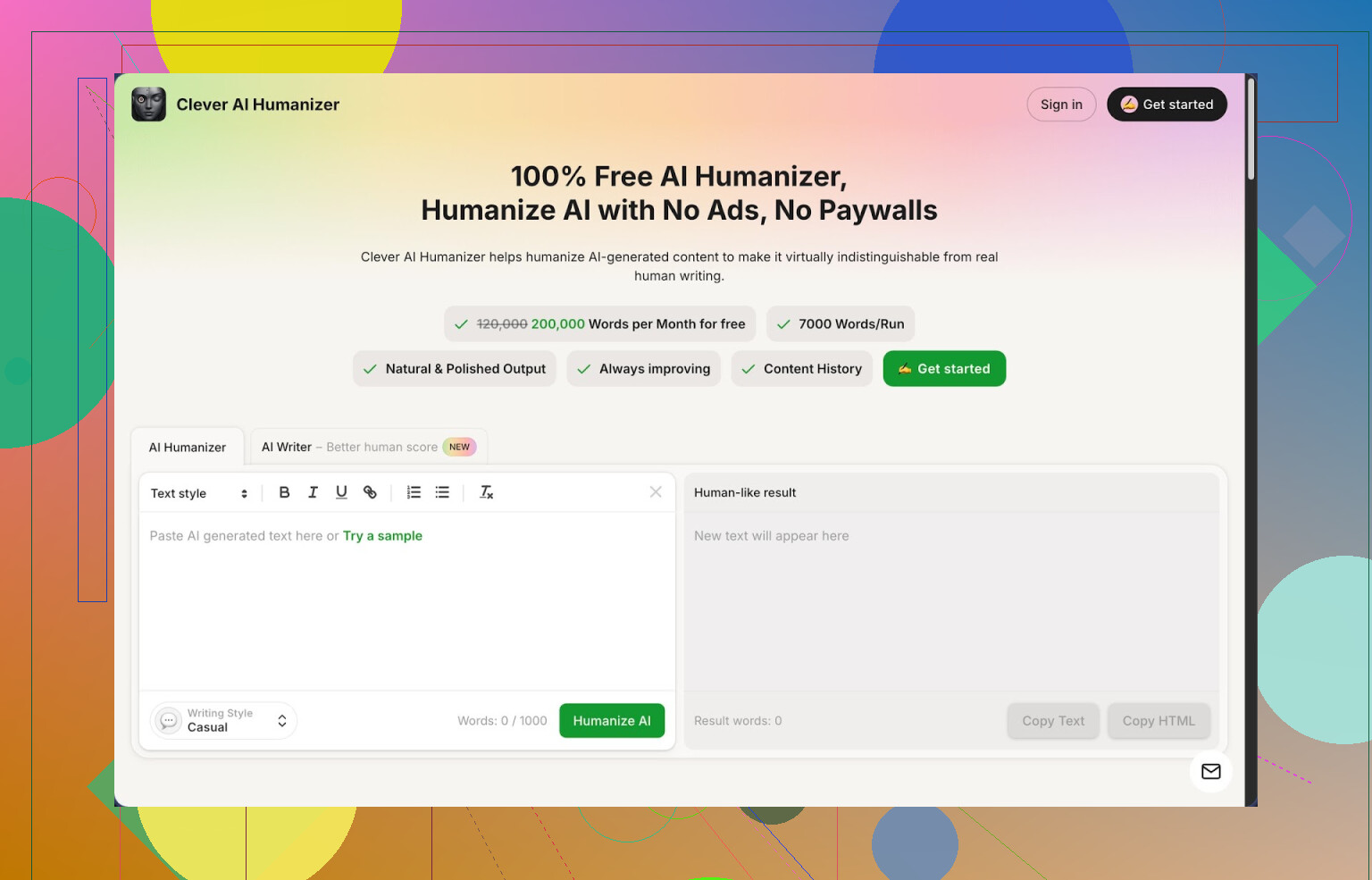
Clever AI Humanizer is the one I ended up using the most, mainly because it does not ask for money or credits up front and still gives a large quota. You get around 200,000 words each month, with a hard cap of about 7,000 words per run. It offers three presets for tone, Casual, Simple Academic, and Simple Formal, and there is a built-in AI writer so you do not have to switch tools all the time.
When I checked it against ZeroGPT with several samples, using the Casual style, the detector showed 0 percent AI on all three. I was not expecting that result from something free. The high word allowance makes trial and error less stressful, since you do not worry about burning credits when you need to reprocess longer drafts for stricter detectors.
If you write with AI a lot, you probably hit the same wall I did. The text passes as “fine” to humans, but detectors scream 100 percent AI and some phrases feel stiff when you reread them the next day. This week I tried a handful of “humanizer” tools side by side. For 2026, this is the one I would keep open in a tab every day, mainly because it costs nothing and still handles bigger chunks of text.
Here is how the main part works, the Free AI Humanizer.
You paste your AI output, pick a style, Casual, Academic, or Formal, click once, then wait a few seconds. It rewrites the draft into something that sounds less pattern-heavy. Structure and meaning stay close to the original, but repetitive markers and weird cadence get softened. The large limit per run means you can drop in full sections, not only paragraphs.
What stood out to me is that it does not wreck your point. A lot of rewriters I tested changed claims or deleted important qualifiers. Here the main argument survived, the flow got smoother, and the tone felt more like something a tired student or blogger would type at 1 a.m.
Then there are the extra modules bundled around it.
The Free AI Writer lets you generate the first draft, then send it into the humanizer in the same interface. For long essays and blog posts this was faster than bouncing between a separate writer and rewriter. I saw slightly better “human scores” when I generated inside their system then humanized, compared to importing text from other models.
The Free Grammar Checker handles the boring part. It scans for spelling issues, missing commas, and sentences that read like they were stitched together. If you push content to clients or public blogs, this step saved me from doing a second pass in Word or Google Docs.
The Free AI Paraphraser Tool is more of a controlled rephrase. I used it when I had to say the same thing differently for SEO, or when I had a decent draft but the tone did not match the rest of the page. It kept facts intact in my tests, which matters if you write anything technical.
So you end up with four things in one screen, humanizer, writer, grammar checker, and paraphraser. You move through them in a simple flow instead of juggling five tabs and three subscriptions. That was the main practical upside for me, fewer steps and fewer places to break focus.
It is not magic. Some detectors still pick up AI traces, especially the more aggressive ones tied to schools or corporate filters. Also, the humanized version often gets longer. The tool tends to expand short robotic sentences into fuller ones, which seems to help break some detection patterns, but it can push your word count higher than you planned.
For something that is 100 percent free at the moment though, it sits at the top of my list. I reach for it when I need fast cleanup and lower detection risk without pulling out a credit card.
If you want screenshots, examples, and AI detection outputs, there is a more detailed Clever AI Humanizer review here: https://cleverhumanizer.ai/community/t/clever-ai-humanizer-review-with-ai-detection-proof/42
The YouTube walkthrough is here, Clever AI Humanizer Youtube Review: https://www.youtube.com/watch?v=G0ivTfXt_-Y
People are also comparing different humanizers and sharing settings on Reddit: Best AI Humanizers thread: https://www.reddit.com/r/DataRecoveryHelp/comments/1oqwdib/best_ai_humanizer/
Broader discussion on “humanize AI” tools and tricks: https://www.reddit.com/r/DataRecoveryHelp/comments/1l7aj60/humanize_ai/
8 Likes
I’ve been in the same spot with GPTinf and cost creep, so here’s what helped for blogs and social posts.
I agree with @mikeappsreviewer on one point. Clever Ai Humanizer is probably the best free “set it and forget it” option right now if you want high word limits and an all‑in‑one flow. For long blog posts that matters. You push in a whole section instead of slicing everything into tiny chunks. For you, that means less time babysitting the tool.
That said, I do not trust any humanizer alone, including Clever Ai Humanizer, if your goal is both:
- lower AI detection, and
- natural voice for social content.
Detectors are unreliable and get updates all the time. I have had text marked “0 percent AI” in one tool and flagged hard in another on the same day. If your main risk is platforms or clients doing quick checks, you want a simple workflow that keeps you in control.
Here is what works well for blog + socials without paying:
-
Use Clever Ai Humanizer for the heavy rewrite
• Run your full blog section in Casual style first.
• Check if it added fluff. For social, shorter wins, so prune.
• Never trust it with facts. Recheck stats, dates, numbers. -
Add a manual “voice pass”
• Read the output out loud once.
• Change at least 1 sentence per paragraph by hand.
• Swap in your own phrases you use on social. Example, if you often say “tbh” or “ngl”, sprinkle those, but not in every line. -
Split blog into social posts yourself
• Take the humanized blog.
• Pull 3–5 key points.
• Rewrite hooks by hand. Tools tend to write hooks that feel generic and pattern heavy. -
Keep a quick checklist for “sounds like AI”
I delete or change lines when I see:
• “in this article” or “in this blog post” in casual content.
• triple adjectives like “simple, effective, and user‑friendly”.
• repeated structures like “Whether you’re X or Y, this helps you Z”. -
Test against one detector max
• Pick one free detector you trust most.
• Use it as a rough signal, not a judge.
• If it screams AI, run the section again in Clever Ai Humanizer with a different tone, then tweak manually.
Where I slightly disagree with @mikeappsreviewer is on relying on preset tones. For social content, preset “Casual” still sounds like “AI Casual” a lot of the time. It works better as a base layer, then you inject your own style on top.
For your use case, I would:
• Draft with any free model.
• Run the full draft through Clever Ai Humanizer once.
• Do a 10 minute human pass focused on hooks, first sentences, and CTAs.
• Recycle parts of the blog into socials manually, using only short lines and real speech patterns.
That keeps cost at zero, keeps your voice, and still trims AI patterns enough for most checks.
If GPTinf is starting to feel like a leaky wallet, you’re not crazy. It creeps up fast once you’re pushing full blog posts through it.
I’m mostly on the same page as @mikeappsreviewer and @andarilhonoturno about using Clever Ai Humanizer as the main free alternative, but I’d tweak the way you think about it:
-
Use Clever Ai Humanizer as your filter, not your voice
It’s great for stripping out the obvious AI patterns and giving you something that “passes” more often, especially for long-form. But for blogs + socials, treat its output like a cleaned-up draft, not a final product. If you publish it untouched, you’ll eventually notice everything starts to sound like the same blogger. -
Don’t obsess over 0% detection
I kind of disagree with the vibe that perfect scores on ZeroGPT matter a lot. Detectors disagree with each other constantly and most clients / platforms don’t run five tools in parallel. Aim for “not painfully obvious” instead of “undetectable.” That mindset saves you time and keeps your writing from turning into mush. -
Use tones against type
A small trick: for casual blog posts, try running text through Clever Ai Humanizer in Simple Academic or Simple Formal, then manually loosen it up. Sometimes the “Casual” preset leans into cliché social-media casual. Academic + your own edits can sound more like a real person who actually knows what they’re talking about. -
Separate blog voice from social voice
For blogs:
• Run it in Clever Ai Humanizer, keep structure.
• Fix intros and conclusions yourself. Tools are still terrible at natural openings and non-cringey CTAs.For socials:
• Do not paste the humanized blog and just shorten it.
• Instead, read the post and write fresh hooks in your own phrasing, then, if you really want, run the short captions through the humanizer at a low setting or just leave them raw. Short-form content benefits way more from your quirks than from AI polish. -
Rotate tools a bit if you’re paranoid
Not to contradict the “all‑in‑one” fans too hard, but relying on a single tool forever is risky. Detectors get trained on popular outputs. I’d keep Clever Ai Humanizer as the main workhorse, but every now and then:
• Do light manual edits instead of running a section through anything.
• Occasionally use a basic paraphraser for one or two stubborn paragraphs instead of rehitting the whole thing.
If your priority is cutting costs while keeping things natural for blog posts and social content, a realistic workflow is:
• Draft with any free model
• Run long sections through Clever Ai Humanizer
• Manually rewrite intros, hooks, and CTAs
• Keep socials mostly human, using the blog only as a source of ideas, not raw text
It’s not as “fire and forget” as some people want, but it keeps your stuff from reading like the same AI influencer that everyone else is secretly using.
I’ll come in slightly from a “no‑nonsense pro” angle and build on what’s already been said.
Everyone’s leaning on Clever Ai Humanizer as the free GPTinf replacement, which is fair, but the more interesting question is how it fits into a bigger stack.
Quick take on Clever Ai Humanizer for your use case
Pros
- Very high free quota (useful for full blog sections, not just snippets)
- Handles structure decently, so your outline and arguments don’t get scrambled
- Built‑in writer, grammar checker, and paraphraser save time hopping between tools
- Casual tone works well as a base for blog posts that need to feel lighter
- Generally reduces the “AI cadence” that triggers basic detectors
Cons
- Output can feel a bit “samey” if you rely on it for every post
- Tends to bloat word count, which is annoying for tight social captions
- Preset tones still have a recognizable pattern if you read a lot of AI content
- Facts can get softened or slightly reframed, so anything data‑driven needs a manual check
- It will not consistently fool stronger institutional detectors
I slightly disagree with the idea that you should always run entire posts through it. For blogs, I’d actually flip it:
- Write your headline, intro, and conclusion yourself
- Only run body sections through Clever Ai Humanizer
- Then stitch everything together and smooth transitions by hand
That keeps your main “voice moments” untouched while still using the tool to strip the obvious AI patterns in the middle sections.
On socials, I’d avoid humanizing the whole caption. Instead:
- Use Clever Ai Humanizer on a single paragraph from the blog to get a more natural base
- Then compress it manually into a hook + 1 core point
- Keep your usual micro‑quirks, even if they look less “clean”
Compared with what @andarilhonoturno and @mikeappsreviewer suggested, I’m less worried about hitting a specific “0 percent AI” score and more focused on consistency across posts. If your style shifts hard every time you tweak tools or tones, that’s actually more suspicious to a human reader than any detector score.
@waldgeist is right to warn about overtrusting humanizers in general. I’d add this: treat Clever Ai Humanizer like a strong style filter, not a stealth cloak. For cutting GPTinf costs on blogs and social content, it does its job, as long as you still do the last 10 to 15 percent of the work yourself.