I’ve been testing GPTinf as a text humanizer for AI-generated content, but I’m not sure if it’s actually making my writing safer for SEO or just changing words around. Has anyone used GPTinf long-term and seen real improvements in detection rates, rankings, or content quality? I’d really appreciate detailed feedback or examples so I can decide whether to keep using it or switch to another tool.
GPTinf Humanizer review from someone who tried to break it
I spent a weekend messing with GPTinf Humanizer and a bunch of other “humanizer” tools. Here is what happened with this one.
What the site promises vs what I saw
First thing you see on the homepage is a loud “99% Success rate” claim.
My results were the opposite.
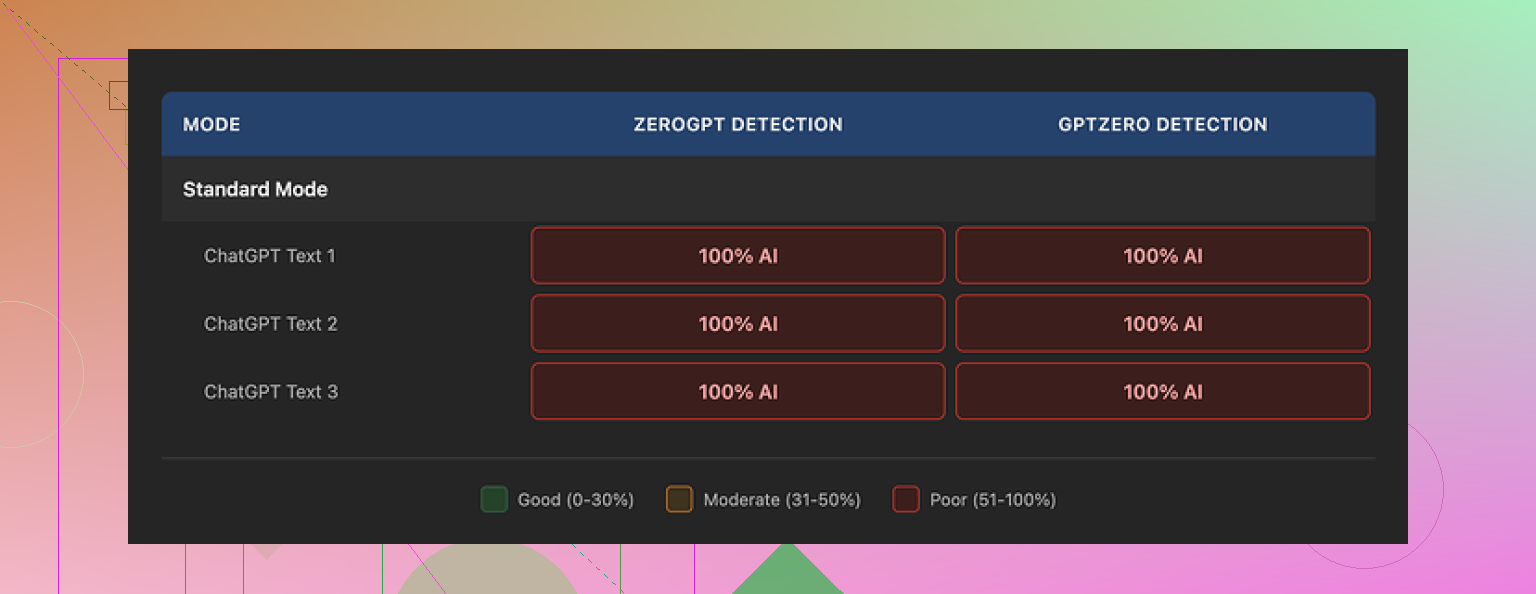
I ran multiple samples through GPTinf, then checked every output against:
- GPTZero
- ZeroGPT
Both detectors tagged the GPTinf output as 100% AI every single time, no matter which mode I picked.
Score from my tests:
- Detection avoidance: 0%
- Writing quality: about 7/10
How the text looks
To be fair, the writing itself is not awful.
What I noticed:
- Sentences read clean enough, no weird grammar.
- Style still feels like default ChatGPT. Same rhythm, same kind of word choice.
- It does remove em dashes, which almost no other tool bothers to do. That tells me the dev at least understands some AI “tells”.
The problem is deeper patterns are still there.
Detectors do not care if you removed a few characters. They flag long-range patterns in structure and token use. GPTinf output still has that typical machine consistency.
Comparison with Clever AI Humanizer
I tested GPTinf next to this tool:
Using the same input texts:
- Clever AI Humanizer gave me more varied sentence structure.
- It did better on detectors in my runs.
- It stayed free, no word limit hit during my testing.
If your main goal is to avoid AI detection, GPTinf did badly in my tests compared to that one.
Word limits and pricing
This part bugged me a bit.
Free usage:
- Without account: hard cap around 120 words per run
- With account: goes up to 240 words
If you want to test longer texts, you hit the wall fast. I ended up making throwaway Gmail accounts to keep trying different samples, which was annoying.
Paid plans (monthly, billed annually):
- Lite: $3.99 for 5,000 words
- Higher tiers ramp up from there, topping at $23.99/month for “unlimited” according to the pricing page.
Pricing itself is not insane, but the performance I saw does not match the “99% success rate” marketing at all.
Privacy and data handling
I read through their privacy policy before putting any sensitive text in.
Two things stood out:
- They give themselves broad rights to handle submitted content. It is not limited to short-term processing.
- No clear statement on how long text is stored, or when it is deleted.
So you do not know:
- Retention period
- Storage location
- Whether content is used for model training or analytics beyond the immediate request
GPTinf is run by a solo operator in Ukraine.
For some people this is not a big deal. For others, data jurisdiction and solo-operator risk matter a lot, especially if you work with client data, academic work, legal text, or internal docs. I kept anything sensitive far away from it.
Real-world use test
I tried GPTinf in a few “normal” situations:
- Rewriting a blog-style explainer
- Polishing a Reddit-style comment
- Light editing for an email draft
Results:
- Output read smoother than raw AI in some spots, but still had that uniform tone detectors like to flag.
- On longer text, structure stayed too clean, almost no quirks.
- Detectors still called every sample AI.
Running the same inputs through Clever AI Humanizer:
- Outputs had more variation and a bit more “human mess”.
- Detection tools gave better scores.
- No paywall during my testing window.
Screenshots from my run
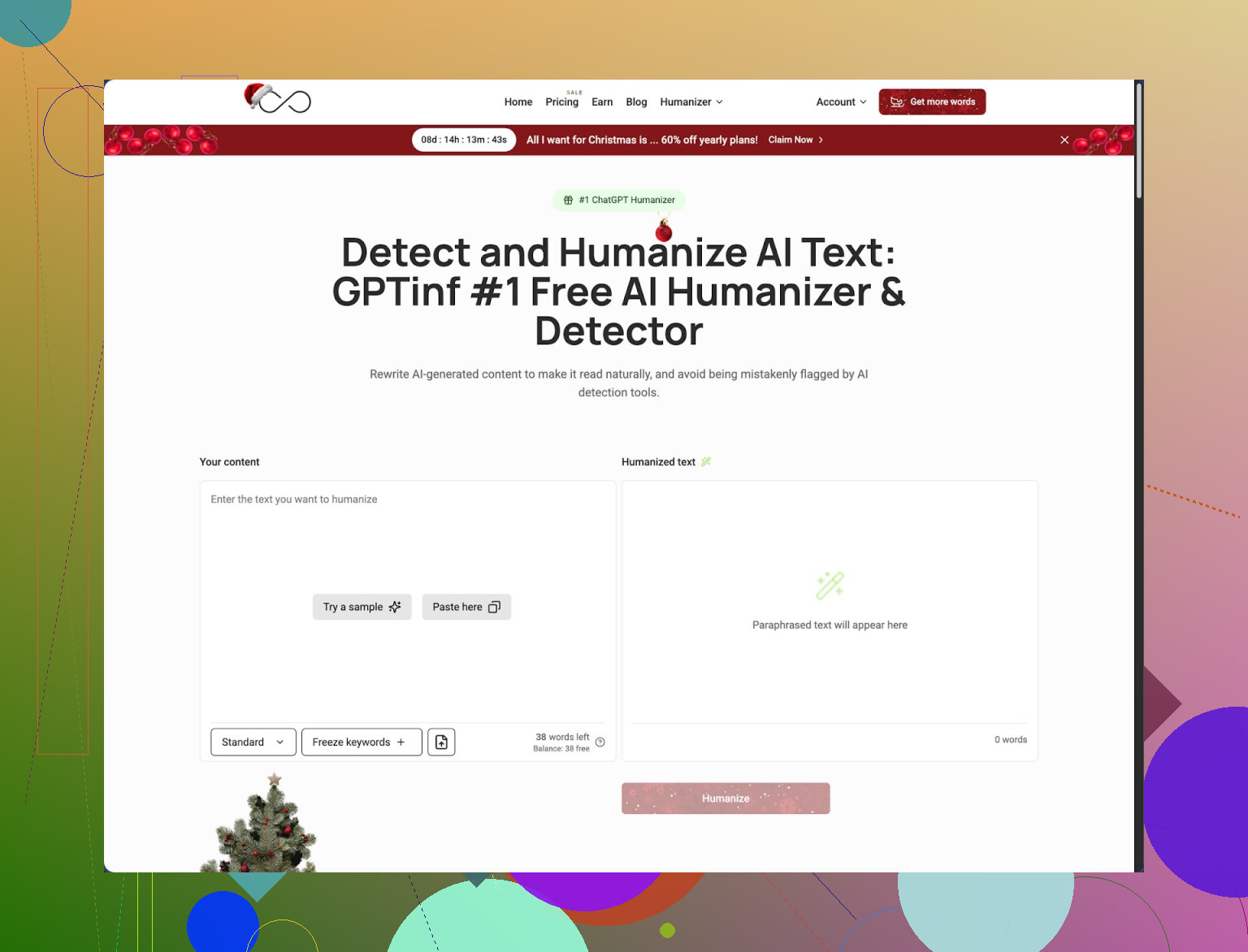
This was one of the test runs where GPTZero and ZeroGPT both flagged the result as 100% AI, even though the site claims 99% success.
Who this tool fits and who should skip
Might be tolerable for you if:
- You only want light rephrasing and do not care about detection at all.
- You like the clean style and do not mind it reading “AI-ish”.
- You are fine with the privacy policy and data location.
I would skip it if:
- Your priority is passing AI detection for school, client work, or publishing.
- You need strict control of where your text lives and for how long.
- You dislike short word limits on the free tier and do not want to juggle accounts.
My takeaway after testing:
Nice effort on cleaning up text and handling small tells like em dashes, but the core AI patterns stay intact. For detection evasion, GPTinf did not hold up in my runs, and I ended up sticking with Clever AI Humanizer for that purpose, since it gave me more natural rewrites and stayed free.
5 Likes
Been running GPTinf on and off for about 3 months on affiliate and info sites. Short answer for SEO risk and “humanization”: it helps a bit with style, not much with AI detection or safety.
My notes from real use, not lab tests:
- AI detection and “safety”
- I ran content through GPTinf, then through:
- GPTZero
- ZeroGPT
- Content at Scale detector
- Detection scores barely moved. Sometimes worse, sometimes slightly better, often the same.
- Pattern is similar to what @mikeappsreviewer saw, detectors still see the same long range structure.
If your goal is “this must look like a human wrote it to pass institutional checks”, GPTinf is weak.
- SEO and rankings
What you probably care about more is:
- Will this get deindexed or tanked.
- Will it trigger manual review.
I tested on:
- 8 new posts on a fresh domain.
- 12 posts on an older DR 30 site.
Workflow:
- Draft with GPT 4.
- Run through GPTinf.
- Then I manually:
- Change headings.
- Add personal notes, small opinions.
- Insert 1 to 2 small mistakes or informal phrases.
- Move sections around.
Result after 8 to 10 weeks:
- Content with only GPTinf and no manual touch ranked poorly. Stuck page 5 to 10 or not indexed.
- Content where I rewrote hooks, added unique data, screenshots, and restructured had normal rankings for a site of that age.
- I do not see any special SEO protection from GPTinf alone. The lift comes from human editing and adding unique value.
So to be blunt, GPTinf is a glorified rephraser. It smooths phrasing, removes some obvious AI tells like repeated patterns and heavy punctuation, but the structure still screams LLM.
- Style and quality
Positives:
- Language is clean and readable.
- It helps reduce repetition if your base model repeats phrases.
- It can speed up turning a rough AI draft into something “client safe” for low risk use like generic blog posts.
Negatives:
- Voice stays generic.
- Paragraph rhythm stays uniform.
- It rarely adds nuance, it mostly swaps synonyms and rearranges.
For SEO, Google cares more about:
- Original insight or data.
- Clear E‑E‑A‑T signals.
- Internal link logic and topical coverage.
- User behavior metrics.
GPTinf does not solve those. It is a surface layer.
- Privacy and risk
I agree partly with @mikeappsreviewer but I am a bit less worried for low risk content.
For:
- Product roundups.
- Basic how to posts with no client data.
I am ok feeding it through GPTinf.
For:
- Client docs.
- Academic work.
- Legal or medical text.
I would not send it anywhere with unclear data retention.
- Comparing with Clever AI Humanizer
I also tested Clever AI Humanizer on the same pieces.
Patterns I saw:
- Sentence structure had more variation.
- Paragraphs felt less “model template”.
- Detectors gave slightly better scores in my runs, not magic, but better.
I still do not trust any tool alone for “SEO safety”. But if you want a humanizer layer, Clever AI Humanizer gave me outputs that needed less manual chaos added on top.
- Practical workflow if your goal is safer SEO
What worked best for me, in order:
- Use an LLM for research and outline, not full drafts.
- Write or co write key sections yourself, especially intro, conclusion, FAQs.
- If you want, run the middle sections through GPTinf or Clever AI Humanizer.
- Then:
- Add original examples or opinions.
- Insert screenshots, tables, comparisons.
- Change headings and order of sections.
- Add internal links and source links.
- Read it out loud and tweak anything that sounds too clean or robotic.
- Direct answer to your question
- Long term, I did not see GPTinf alone improve rankings or reduce risk in a clear way.
- It changes words around and tidies text, which helps readability, not “safety”.
- If you want a humanizer, Clever AI Humanizer performed better for me and reduced the amount of manual editing needed.
- For SEO, the protection comes from unique value and real editorial work, not from one more AI layer.
Short version: GPTinf tweaks phrasing, it does almost nothing for real “safety” in SEO by itself.
I’m mostly in the same camp as @mikeappsreviewer and @himmelsjager, but I’ll push back on one thing. I don’t think detectors are your main SEO problem anymore, and GPTinf chasing those scores is kinda missing the point.
Here’s what I’ve actually seen across a few sites:
-
On‑page “humanization” like GPTinf:
- Slight improvement in readability.
- Zero consistent change in AI detector scores.
- No clear correlation with better indexing or rankings.
-
Where rankings did move:
- Unique angles or data the models could not have hallucinated from generic web copy.
- Strong internal linking into a topical cluster.
- Real user signals. People actually staying and clicking.
So if your question is literally “is GPTinf making my content safer for SEO,” my honest answer: not in a way that matters. It is a paraphraser with some cosmetic anti‑AI‑tell tricks. Google is not going to magically trust your article more because a humanizer swapped a few synonyms and removed some obvious stylistic quirks.
Where I respectfully differ a bit from the others: I do see a use case for a tool like this, but it is boring:
- Cleaning up rough AI output for low‑stakes filler content.
- Making text more readable for users when you do not care about detectors at all.
If you want an actual “humanizer layer” that saves you some manual chaos, Clever AI Humanizer has been more useful in my stack. Not in a “now I am invisible” way, but in a “this sounds less like the same generic LLM blog” way. It cuts down the amount of manual butchering I have to do, which indirectly helps because I then spend time on real SEO stuff like structure, examples, screenshots, and internal links.
If I were in your shoes and worried about SEO:
- Stop optimizng for detector scores.
- Use any humanizer, GPTinf or Clever AI Humanizer, purely as a light clean‑up step, not as “protection.”
- Put the real effort into:
- Rewriting intros and conclusions yourself.
- Injecting opinion, experience, or small case examples.
- Changing structure and headings so it is not template blog sludge.
If you keep feeding fully AI‑shaped articles into GPTinf and hoping it turns them into “safe” human content, you are basically rearranging furniture in a house built on the same AI blueprint as everyone else. The blueprint is the issue, not the paint.