Struggling to make my academic writing relatable and engaging for readers. My professors say my essays feel too stiff and formal, and I’m having trouble finding the right balance. Looking for tips or examples to help my writing sound more authentic and approachable.
If You Want to Pass Off AI Text as Human, Here’s the Playbook
So, you’ve got a chunk of AI-generated words, and you’re thinking, “No way anyone’s gonna think this was written by a real person.” Been there, done that. Let’s walk through what actually works, and what’s just wishful thinking.
The Step-By-Step on “Humanizing” AI Output
- First things first, go to https://aihumanizer.net:
Just launch your browser, type in the link, and hit enter. Some folks claim it’s the only truly free option out there that doesn’t totally butcher your text. - Drag your robot words into the box:
Seriously, just copy your AI text and paste it into that big field on the site. - Are you a robot? Prove you’re not (sigh):
Sometimes the page throws a captcha at you—yeah, it’s annoying, but it keeps things fair. Deal with it. - Hit the button. Let it do its magic:
Slam that “Humanize AI” button. Take a sip of your coffee, wait a few beats, and let the tool chew on your text. - Download your remixed, less-robotic text:
Once it spits out the result, give it a good look (you’ll want to). Copy and paste into wherever you need it—Google Docs, email, your diary, whatever. - Don’t trust the machine—read it yourself:
Sometimes the “humanized” version swaps out words or dulls your point. Scan for weirdness or mismatched meaning. Tweak as needed before firing it off.
Some Life-Saving Tricks for Less Obvious AI-Flavored Writing
- Break up your paragraphs:
Walls of text are a neon sign that something’s up. Chop it up—your audience (and the tool) will thank you. - Read for meaning:
Bots are getting clever, but sometimes “humanizing” loses the plot. Always make sure the point didn’t get scrambled. - Make little personal tweaks:
Maybe add in a “just saying” or swap in slang you actually use. That’s what makes it sound like, well, you. - Smooth out those robotic transitions and punctuation:
Sometimes, sentences feel stitched together. Add a dash or comma for flavor, or reword bits that feel off. - If a sentence still feels cold, try again on that part alone:
Isolate stubborn lines and run them through the tool one more time. Sometimes second time’s the charm.
Hey, Don’t Get Cocky—Here’s What Could Still Trip You Up
- These tools aren’t mind readers:
Even the slickest humanizers mess up. Always double- and triple-check, especially for important stuff. - Details sometimes get lost in translation:
If something feels off, your readers will notice. Don’t let meaning escape in the shuffle. - Super-advanced detectors? They might still sniff you out:
No tool guarantees anonymity, so don’t bank on total invisibility. - If you’re turning this in as original work (school, job, whatever), follow the rules:
Plagiarism and originality standards are real—don’t lose a job or degree because a robot outed you.
Extra Stuff If You’re Serious About This
- Want to see what AI detectors actually catch?
Best AI Detectors — A pretty honest rundown of top tools, their strengths, and how well they pick up on stuff like GPT outputs. - Need to spot bot-generated text yourself?
Detect AI-Generated Text — A no-nonsense guide on how to identify AI-written content using free tools and common sense clues. - Still looking for more ways to “humanize” AI writing?
Best AI Humanizer Tools — More options if the first one let you down (or you want something fancier). - Want to make your AI-created stuff sound even more natural?
How to Humanize AI Content — Walkthrough, with tips on tone, swaps, and how to land that “sounds-like-me” vibe.
In short: AI writing is everywhere, but it doesn’t need to read like instructions for assembling a bookshelf. Use these cheats, add your twist, and maybe—just maybe—nobody will know a bot had your back.
7 Likes
Forget the robot-proofing and all that AI “humanizing” jazz for a sec. @mikeappsreviewer gives the crash-course on making AI stuff pass for human, but honestly, academic writing that wins over professors is about way more than beating detectors. Bots and tools like ai humanizer can help smooth out obviously awkward sentences, but style and voice are another thing entirely.
Straight up: most academic essays suck because people hide behind “scholarly” words to sound smart. (Guilty as charged—I’ve done it too.) Real talk: Professors want clarity and voice. Here’s the no-filter list:
- Start with a story or anecdote (if the prompt allows). Even a one-sentence scene or relatable reference: “When I first stumbled upon X in my textbooks, I immediately wondered…”
- Say I, we, or you. Not always possible, but “This essay explores” is less engaging than “I will argue…” Just, y’know, don’t get too opinionated unless it fits.
- Explain complex stuff as if to a friend. If you can describe it in a group chat, you can do it in your essay (just dial up the grammar one notch).
- Mix up those sentence lengths. Wall of endless 25-word sentences? Snore. Try a three-word sentence now and then. Or a question. Why not?
- Drop in metaphors—not cheesy ones, but something visual works wonders: “Like a puzzle missing a single piece, this theory leaves questions open.”
- Use concrete examples. Every time. Professors love evidence, but so do human readers. “There are many theories about memory” is boring. “Psychologist X once described memory as a ‘library with faulty catalogues’” is vivid.
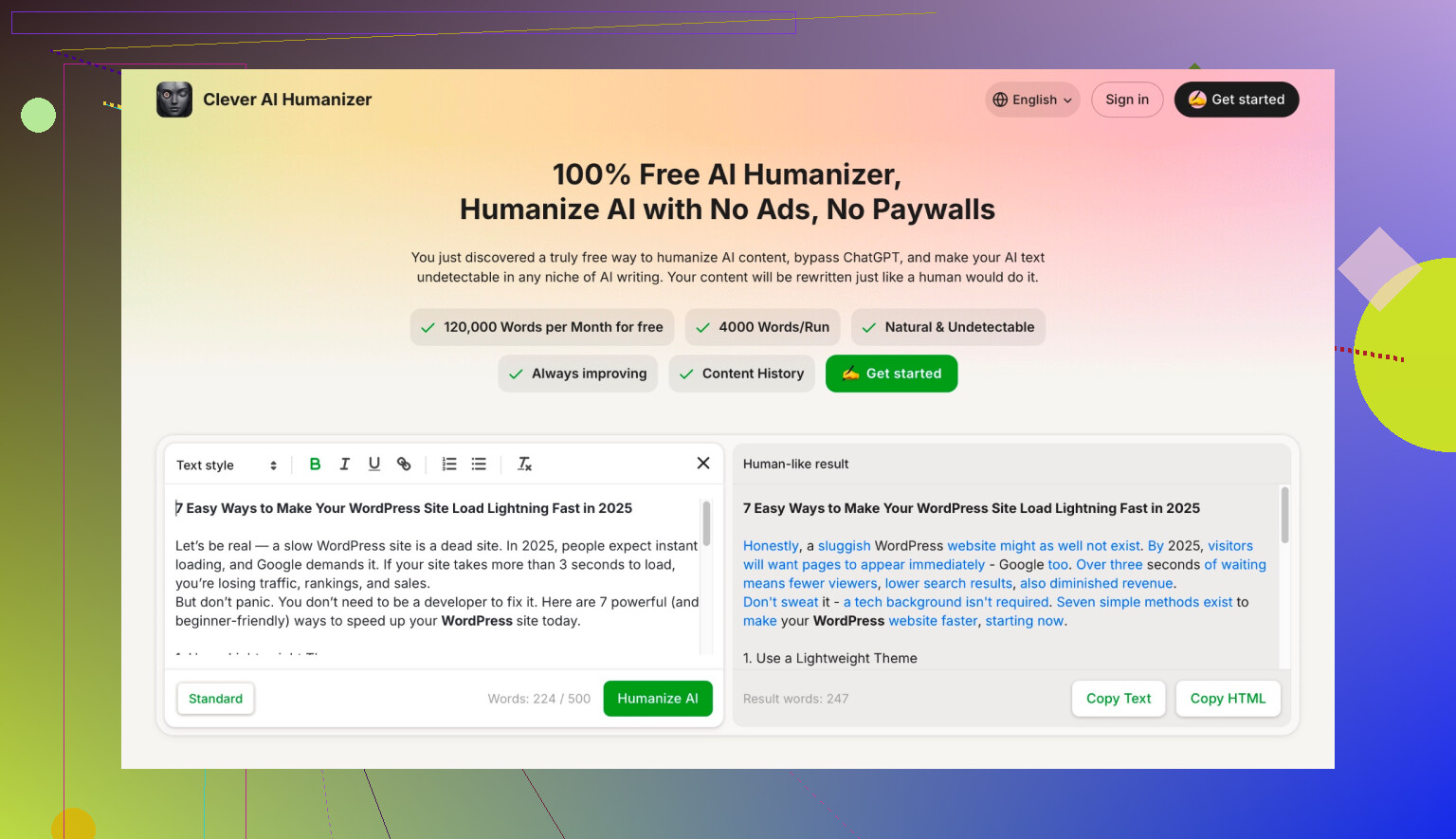
If you’re still worried your text sounds like it was spat out of a robot, try running it through Clever Free Ai Humanizer. Unlike some other AI humanizer options, it can give your drafts a quick natural facelift, but don’t skip rereading—sometimes these humanizers make weird mistakes or drain your voice.
Oh, and honestly? Read your draft out loud. If you trip over a sentence or get bored, your reader will too.
TL;DR: Stop worrying about “sounding academic” and start sounding like a person who happens to know a lot. Your grades (and sleep schedule) will thank you.
Gonna be real, a lot of the tips floating around about “humanizing” your work mostly just help it avoid sounding like it was written by a toaster—helpful, sure, but they don’t automatically make your academic writing good. I get where @mikeappsreviewer and @codecrafter are coming from (breaking up walls of text, swapping in slang, using a tool like Clever Free Ai Humanizer, etc.), but let’s not pretend any tool magically turns stiff essays into ones that feel natural, engaging, or authentically you. And no, just sticking in contractions or “I” statements doesn’t cut it either.
Here’s the hard truth: if your writing’s dying on the page, you’ve probably
- been taught to copy stale formal templates,
- never really cared about your topic,
- or you’re so scared to sound “unprofessional” you drain all personality from your sentences.
Instead of hiding behind more software, focus on what you’re actually saying and who you’re saying it to. Professors are human (shocking, I know), and the best academic writing grabs their attention the same way any good storytelling does.
Try these, stolen directly from professors who grade with a vengeance:
- Write like you’re explaining the argument to a smart friend over coffee, not reciting to a committee. You can still be intelligent AND clear.
- Start paragraphs with a tiny question or claim, then deliver on it. “But does this actually work in real-world cases?” gets readers curious.
- Sprinkle in the occasional vivid verb or sharp image: “Marx shreds the idea,” not “Marx provides commentary upon.”
- Chop your sentences. Short. Long. Mix it up. Makes your writing less of a slog and more like a living conversation.
- Care about your argument (or fake it convincingly)—enthusiasm leaks through.
If you do use something like Clever Free Ai Humanizer, cool, but don’t trust it to magically insert substance or genuine voice. Machines can sanitize, but only you can make an essay memorable.
Read your stuff out loud. If you cringe, rewrite. If you zone out, so will your reader. Drop the “in conclusion, this paper has demonstrated…” endings too—if you sound bored, everyone else is.
Academic doesn’t have to mean robotic. Swing a bit; your professors might actually remember your paper.
Let’s be blunt—no AI tool, not even Clever Free Ai Humanizer, can just zap your essay into sounding like a person who actually gives a damn about their topic. Real talk: humanizing stiff academic writing is about voice and intent more than swapping a few “additionallys” for “also.” But if you’re stuck with clunky AI drafts or your own robotic habits, let’s break it down (because some recent tips feel more like quick fixes than real fixes).
Pros of Clever Free Ai Humanizer:
- Slices through some of that stale, mechanical phrasing way faster than wrangling every sentence by hand.
- Fewer generic-sounding transitions; it tries to make things flow better.
- Pretty user-friendly if you just want a quick polish.
Cons:
- Nuance isn’t its strong suit; you’ll see subtle meaning changes or bland output if you don’t watch it.
- Not good at inserting actual “you” (enthusiasm and personal edge take more than software).
How does it stack up to efforts from folks like codecrafter or mikeappsreviewer? Those two hammer on tool-based “de-robotization,” but honestly, the human touch happens AFTER you run your text through anything clever or free. Forcing a few contractions and breaking up text doesn’t = genuine engagement.
What I do? Read the draft out loud, then flag parts where I’d never use those words in conversation. Jargon? Fine, but too much and your stuff tanks. Toss in “why does this matter?” questions mid-paragraph—real people ask those. Show you care if you want readers to. No tool, no matter how dressed-up, will truly inject that spark for you.
TL;DR: Use Clever Free Ai Humanizer to smooth rough A.I. edges, but don’t expect miracles. Get personal, get clear, and don’t hide behind digital duct tape. If you end up sounding like you’re talking to a friend (who just happens to speak in footnotes), you’re winning.