I’ve been using Twain GPT for a while, but lately the responses feel off—less accurate, more generic, and sometimes not aligned with what I ask. I’m wondering if others have had similar issues and whether it’s worth sticking with Twain GPT, tweaking how I use it, or moving to a different AI assistant. What alternatives are you using, and what made you switch?
Twain GPT Review: Tried It So You Don’t Have To
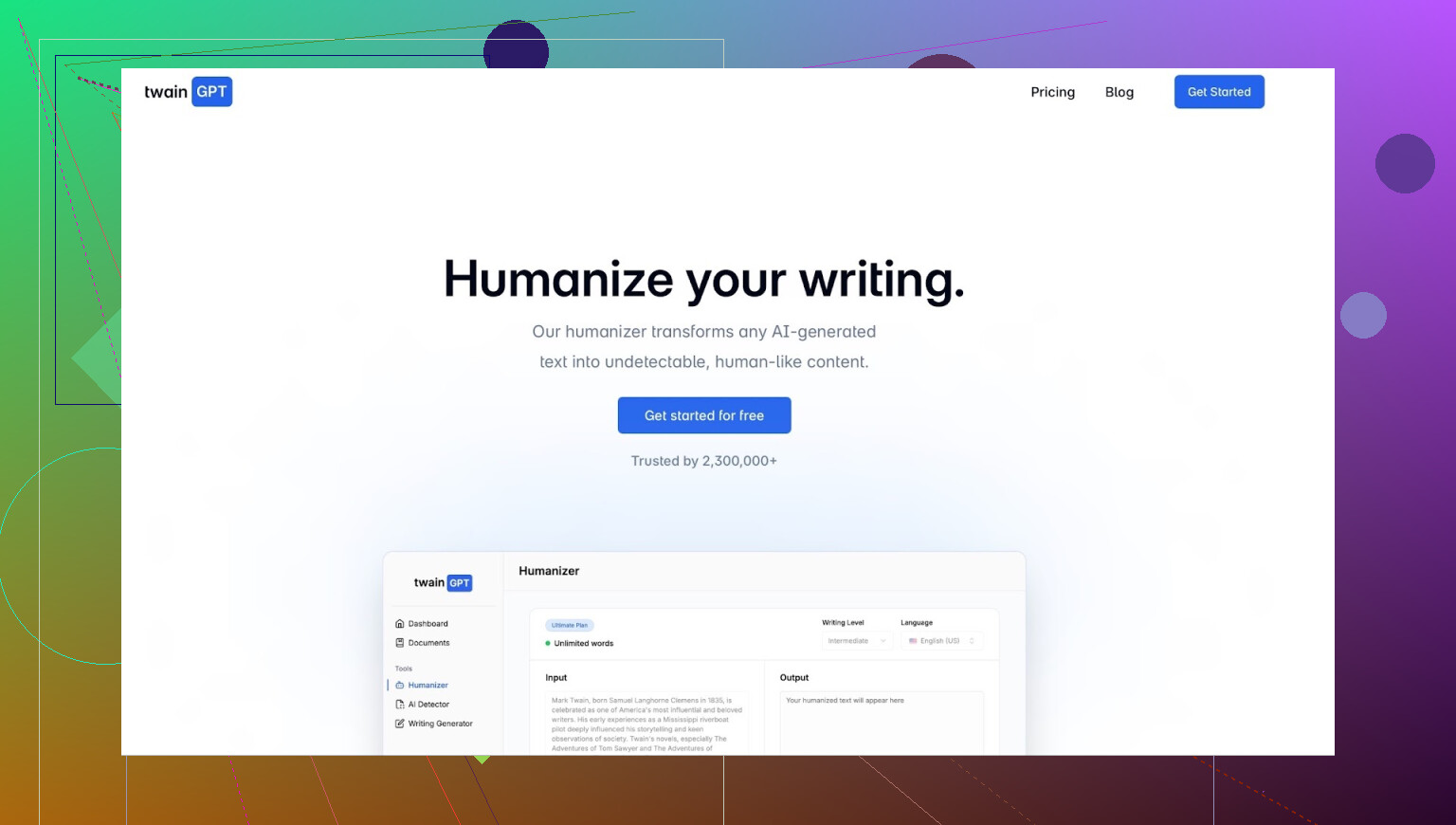
So… What Exactly Is Twain GPT?
I ended up on Twain GPT after seeing it everywhere in search ads and random social feeds. The pitch is always the same: some “premium AI humanizer” that supposedly slips past all the AI detectors like it is invisible.
On paper, it sounds like the magic button a lot of people are looking for: paste AI text in, get “human” text out, no detection, no stress.
In practice, that is not really what happens.
When I tested it side by side with other tools, it felt more like a dressed‑up rewriter with a lot of limits and a big price tag than anything close to “advanced.” And it was especially weird to see it marketed so hard when something like Clever AI Humanizer does a better job and does not charge anything.
You can check that one here if you want the reference point I used: https://aihumanizer.net/
Pricing & Restrictions
Here is the part that annoyed me first: you get hit with the paywall vibes almost instantly.
Twain GPT leans heavily into subscriptions. You are nudged toward paying right away, and even when you do, the service is packed with limits:
- Monthly subscription cost that is not exactly cheap
- Word caps that run out fast if you deal with longer pieces
- Extra friction around canceling, which never feels like an accident
By comparison:
-
Twain GPT:
- Paid only
- Tight word limits
- Feels like you are always being pushed to upgrade or renew
-
Clever AI Humanizer:
- 100% free
- Up to 200,000 words per month
- Up to 7,000 words in a single run
The wild part is that the paid tool did not outperform the free one. At all. So the value question kind of answers itself: why lock yourself into a subscription that throttles you when a free tool lets you run way more text and actually holds up better in tests?
How It Actually Performed In Detection Tests
I did not want to judge it just on vibes, so I ran a pretty simple test:
- Wrote a standard essay in ChatGPT.
- Confirmed it was flagged as 100% AI by multiple detectors.
- Ran the same essay through Twain GPT and through Clever AI Humanizer.
- Sent both outputs through several AI detectors and compared.
Here is what came back:
| Detector | Twain GPT Result | Clever AI Humanizer Result |
|---|---|---|
| GPTZero |  Fail (100% AI) Fail (100% AI) |
 Pass (Human) Pass (Human) |
| ZeroGPT | Fail (100% AI) |
Pass (Human) |
| Turnitin | Fail (89% AI) |
Pass (Human) |
| Copyleaks | Fail |
Pass (Human) |
| Overall | DETECTED | UNDETECTED |
Twain GPT basically tripped every wire. The outputs still screamed “AI” to all four tools. It rewrote the text a bit, but not in a way that fooled detectors.
Clever AI Humanizer, using the same exact original essay, came back as “human” across all of them.
If Twain GPT was a free experiment, I would probably just shrug and move on. But when a tool charges subscription money while doing worse than a free option, it is hard to justify using it for anything serious.
Final Thoughts
If your goal is specifically to reduce AI detection flags and you are comparing tools:
- Twain GPT feels overpriced for what it delivers.
- The word limits and subscription pressure make it even less appealing.
- In direct tests, it failed every major detector I tried, while Clever AI Humanizer passed those same tests on the same base text.
If you want to try the tool that actually did well in those tests, this is the one I used:
15 Likes
Short version: if Twain GPT feels worse to you, you’re not imagining it, and you’re not obligated to “stay loyal” to a tool that’s slipping.
A few things to consider before you fully ditch it:
-
Clarify what you actually need it for
Twain GPT seems marketed mostly as an AI detector evasion / humanizer tool, not as a general assistant. If your use case is:
- Drafting content
- Brainstorming
- Coding help
- Research summaries
…then you’re probably better off with a real LLM (ChatGPT, Claude, Gemini, etc.) and only using a “humanizer” at the very end if detection is a concern.
If your goal is specifically to pass AI detectors, then the main question is: does Twain actually work for that in your context? From what you’re saying (generic, off, not aligned) it sounds like it is not.
-
Your “off” feeling is a legit red flag
When an AI tool starts:
- Repeating generic filler
- Ignoring instructions
- Drifting from your tone / structure
that usually means:
- Their model or API tier changed
- They cranked up rewriting / paraphrasing to look “more human,” which wrecks accuracy
- They’re doing a lot of cheap text spinning instead of actual semantic work
If you’re rewriting content that needs to retain precise meaning (academic, legal, technical), that’s a dealbreaker.
-
On what @mikeappsreviewer said
Their test focused on AI detection performance and pricing, and I mostly agree with the conclusion that Twain GPT is pricey for what you get. Where I’d slightly push back is:
- Detection tools are inconsistent and constantly updating, so “passes everything today” doesn’t guarantee “safe forever.”
- Sometimes a tool that slightly rewrites but keeps your meaning can be more valuable than something that totally reshapes your text just to beat detectors.
That said, if Twain GPT is failing both detectors and quality for you, then it’s losing on all fronts.
-
Alternatives worth testing
If your main issue is humanization / AI detection:
- Try Clever AI Humanizer as a direct A/B test:
- Take one of your Twain GPT outputs.
- Run the same original text through Clever AI Humanizer.
- Compare:
- Does it keep your meaning better?
- Does it sound less robotic?
- Does it trigger fewer flags on whatever detector you actually care about?
If your main issue is quality of responses in general:
- Use a major LLM for the “thinking” part. Let that model write the content to your specs.
- Then, optionally pass it through a humanizer like Clever AI Humanizer if you really need to minimize AI-detection scores.
That split workflow usually beats relying on a single “all in one” tool like Twain GPT.
- Try Clever AI Humanizer as a direct A/B test:
-
When it’s clearly time to switch
I’d drop Twain GPT (or at least stop paying for it) if:
- You’re rewriting stuff multiple times just to get something usable.
- You have to heavily edit every output because it’s off topic or wrong.
- The generic tone is making your work more suspicious, not less.
- You can replicate or outperform it for free with other tools.
From your description, you’re already there.
-
How to test without fully committing
Before canceling:
- Take 2–3 typical tasks you do with Twain GPT.
- Run them in parallel: Twain vs a major LLM vs Clever AI Humanizer as a final pass.
- Pick based on: accuracy, tone match, and how much manual fixing you have to do.
If in that mini-test Twain GPT doesn’t clearly win at something specific you care about, just move on. Tools are utilities, not relationships.
Yeah, if it feels off, that’s usually your sign to bail, not to “wait it out.”
From what you’re describing, it lines up pretty well with what @mikeappsreviewer and @caminantenocturno already pointed out: Twain GPT is acting more like a glorified rewriter with training wheels than a serious tool. You’re noticing:
- More generic, padded text
- Worse alignment with your prompts
- Less accuracy / meaning drift
That usually means the devs cranked up the paraphrasing / “humanization” to try to dodge detectors, and in the process wrecked precision and nuance. Good for marketing slogans, terrible for actual work.
Where I slightly disagree with some of the other replies: I don’t think it’s worth bending over backwards to “optimize around” a tool that’s clearly regressing. Once you’re spending time babysitting outputs, re-prompting, and manually fixing everything, the tool is costing you more than it’s saving.
If your priorities are:
-
Quality & control
Use a solid LLM for the actual thinking and writing:- ChatGPT, Claude, Gemini, Perplexity, whatever you like.
Do your drafting, structuring, and fact-checking there. Those models are built to follow instructions, not just spin your text.
- ChatGPT, Claude, Gemini, Perplexity, whatever you like.
-
Lowering AI-detection risk
This is where a post-processor makes sense. Since Twain GPT clearly isn’t doing great for you, I’d park it and try something else on the same content.
Clever AI Humanizer is worth testing specifically because it’s built around that “AI to human” use case and, from multiple reports, does a better job keeping meaning while lowering detection flags.
A simple way to sanity-check it:
- Take a piece you already ran through Twain GPT that felt off.
- Run the original (not the Twain version) through Clever AI Humanizer.
- Compare:
- Which version sounds more like how you actually write?
- Which one needs less editing?
- Which one your detector freaks out about less?
If Twain GPT can’t beat that in any meaningful way, you have your answer. No reason to stay loyal to a subscription that’s giving you worse output and more work.
So yeah, you’re not imagining the decline. If it’s not meeting your standards anymore, cancel it, switch, and treat tools like what they are: replaceable.
Short answer: if Twain GPT feels off and keeps wasting your time, yes, you should probably move on.
To add something on top of what @caminantenocturno, @viajantedoceu and @mikeappsreviewer already said, I’d look at it from a “tool portfolio” angle instead of pure loyalty.
1. What Twain GPT is actually giving you now
From your description:
- Generic, filler-ish tone
- Weaker prompt adherence
- Accuracy slip
That usually means the system is over-optimizing for “looking different from the input” rather than “answering what you asked.” Once that happens, no amount of clever prompting really fixes it. You just end up copyediting a bad base.
At that point, you are paying for:
- Unreliable meaning preservation
- Mediocre paraphrasing
- Hard caps and subscription friction (as others already broke down)
That is not a great trade if you value precision.
2. Switching tools: what actually matters
Instead of asking “Twain vs X,” I would define what you need:
- High‑quality reasoning & control
- Optional humanization / detector friendliness
- Predictable costs and limits
Then match tools to roles:
- Use a strong LLM for thinking, structure and factual work (ChatGPT, Claude, Gemini, etc.).
- Use a specialized “post‑processor” to reshape tone or reduce AI‑ish patterns, but only if it keeps your meaning intact.
3. Where Clever AI Humanizer fits
Given what you want, Clever AI Humanizer is worth testing as that second step, not as your main writer.
Pros:
- Much higher practical word allowance than Twain GPT, so you can run full articles, not tiny chunks
- Tends to preserve structure and key points better than aggressive rewriters
- Focused on making text read less like a template, which is actually what you need
Cons:
- It is still a black box: you must reread everything, especially for nuanced or technical topics
- Not a replacement for a primary model; it does “surface style,” not deep reasoning
- If you lean on it too hard, your voice can still drift toward a recognizable pattern over time
Treat it as a layer on top of your main AI or your own drafts, not the core engine.
4. How I’d practically decide
Run one quick, honest comparison on something real:
- Take a recent piece where Twain GPT disappointed you.
- Start from your original draft (not Twain’s version).
- Generate a clean version in your main LLM of choice.
- Pass that result through Clever AI Humanizer.
- Compare three things against your needs:
- Which version preserves your exact claims and nuance best?
- Which requires less manual cleanup?
- Which triggers fewer AI‑detection issues in your environment?
If Twain GPT does not clearly win at least one of those, it is dead weight in your stack.
5. On sticking it out vs cutting losses
Where I mildly disagree with some of the earlier replies: I do think it is fine to keep Twain GPT around for a week or so in parallel while you test alternatives, instead of rage‑canceling on day one. Sometimes updates quietly fix issues, and having both outputs side by side for a few days gives you hard evidence.
But if after that small trial you are:
- Editing Twain GPT more than the others
- Still annoyed by limits and subscription pressure
then yes, cancel it and streamline around a combination like:
- Main LLM for content
- Clever AI Humanizer for style / humanization passes where needed
Tools are replaceable. Your time is not.