I’ve been using Grubby AI Humanizer to clean up and humanize AI-generated text for blog posts and client work, but I’ve hit its free limits and the paid plan is out of my budget. I’m looking for a truly free or very low-cost replacement that gives similar human-like output, can bypass basic AI detectors, and is safe to use for online content. What tools or workflows are you using that can realistically replace Grubby without breaking the bank?
- Clever AI Humanizer review
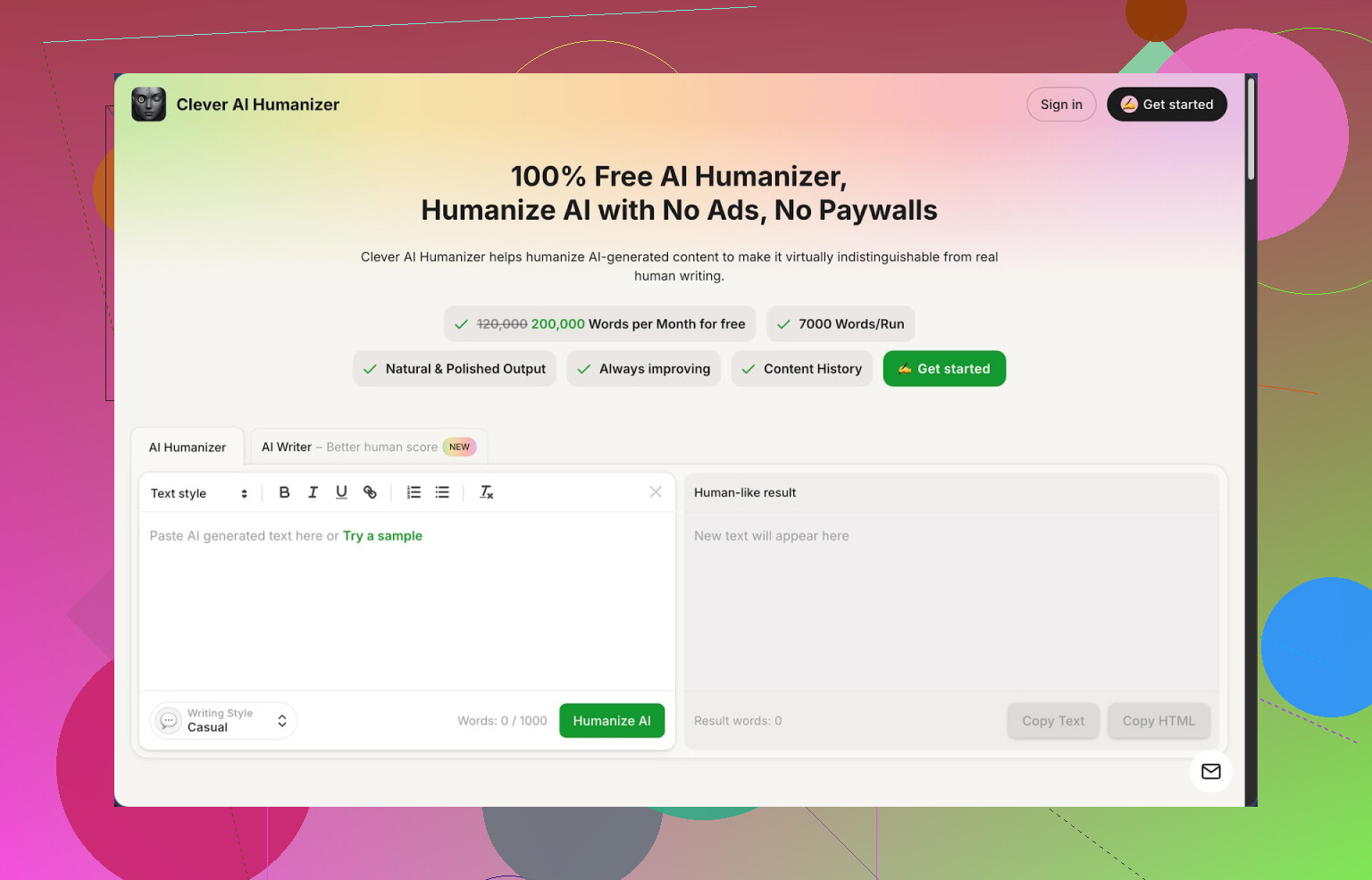
I spent an afternoon messing with Clever AI Humanizer from here:
Short version of what I saw:
• Free tier shows 200,000 words per month
• Up to 7,000 words per run
• Three styles: Casual, Simple Academic, Simple Formal
• Extra tools baked in: AI Writer, Grammar Checker, Paraphraser
No login paywall tricks popped up while I was testing, which was surprising given the limits.
How it handled AI detection
I fed it three different chunks of raw AI output in the Casual style and then checked all of them in ZeroGPT.
ZeroGPT showed 0% AI on each of those samples.
That does not mean it will always score 0% everywhere, so do not bank on it for high‑risk stuff, but for bulk content or low‑risk writing I felt pretty safe with the output.
Using the main humanizer
Flow looked like this for me:
- Paste in your AI text
- Pick style: Casual, Simple Academic, or Simple Formal
- Hit the button and wait a few seconds
- Get a rewritten version that reads less robotic
What helped me most was the decent word limit. I pushed entire articles in one go instead of slicing them into little pieces. If you write longer essays or reports, that alone saves time.
I also tried breaking it by feeding it something with specific terms, numbers, and references. The meaning stayed mostly intact, even when the phrasing changed a lot. I still reread and edited, but I did not see the usual mess like wrong dates or swapped facts.
Extra tools inside the site
This is where it started to feel more like a writing kit and less like a single trick.
- AI Writer
You give it a topic and some prompts, let it spit out a draft, then send that straight into the humanizer from the same interface.
What I did:
• Generated a short blog post with the AI Writer
• Sent that result into the Casual humanizer
• Checked again in ZeroGPT
The “humanized” draft scored better than a plain AI draft I created with another model earlier. It still needed edits for tone and structure, but the machine pattern was lower.
- Grammar Checker
I threw in a messy draft with:
• Missing commas
• Mixed tenses
• Awkward sentences
It cleaned obvious issues, similar to basic grammar tools. Not a full editor, but fine for getting text into “publishable with a quick proofread” shape.
- Paraphraser
I tested this on:
• A short product description rewritten 3 times
• A longer explanatory paragraph I wanted in a different tone
The paraphraser kept the same meaning and changed enough wording so it did not read like a lazy synonym swap. For SEO, this helped when I needed alternate versions of similar sections without repeating exact sentences.
How it fits in a workflow
After a few runs, I ended up using it like this:
• Draft ideas in your usual AI tool
• Paste into Clever AI Humanizer in Casual or Simple Academic
• Run Grammar Checker if the result still feels rough
• Use the Paraphraser only when you need extra variants
It felt faster than bouncing between three different sites. One tab, four tools.
What I liked
From normal user perspective:
• No immediate paywall for decent volume
• Large word limit per run, good for full articles or essays
• Output does not wreck your meaning most of the time
• Clear styles, not fifty confusing options
• All tools sit in one interface, so less tab juggling
Weak points and things to watch
There are downsides, and you should not ignore them.
• Some AI detectors will still flag it
I tried one other free detector and it still thought a part of the text was AI written. You should treat any “0% AI” claim as detector‑specific, not universal.
• Text sometimes gets longer
After humanization, my samples often grew by 10 to 30 percent. That seems linked to how it breaks patterns. If you need strict word counts for assignments or forms, you will spend time trimming.
• Style is a bit “safe”
The Casual style felt readable, but a little generic if you want a strong personal voice. I still had to go back and inject my own phrasing.
Where to read more and see proof
Full detailed review with screenshots and AI detection proof is here:
YouTube review here:

Reddit threads that talk about AI humanizers and related stuff:
Best AI humanizers list:
https://www.reddit.com/r/DataRecoveryHelp/comments/1oqwdib/best_ai_humanizer/
General discussion about humanizing AI output:
https://www.reddit.com/r/DataRecoveryHelp/comments/1l7aj60/humanize_ai/
Who I think this fits
From what I tested, it suits you if:
• You use AI daily for drafts and want quick “de‑AI” passes
• You do not want to pay for yet another writing tool
• You need one simple place for humanizing, basic grammar, and paraphrasing
If you work in high‑risk environments like academic journals, sensitive legal documents, or places with strong policy checks, you should still write your own text or do heavy manual editing on top of this.
For normal content, blog posts, emails, internal docs, and similar things, it felt like a decent free tool to keep in your tab bar.
6 Likes
I hit the Grubby wall too, so here is what worked for me without paying.
First, I agree with @mikeappsreviewer that Clever Ai Humanizer is worth a look, but I would not rely only on its presets if you do client work. The Casual style feels a bit bland for brand voice. For your use, I would treat it as a base pass, not the final version.
Practical setup that keeps everything free or cheap:
-
Main humanizer
Use Clever Ai Humanizer for bulk runs.
Keep it on Simple Formal for client blogs and Simple Academic for anything informational.
Stay under 7k words per run to avoid weird drift in tone. -
Manual “anti detector” tweaks
After Clever, do a quick manual pass. Simple rules help:
• Shorten a few long sentences.
• Add 2 to 3 specific examples from your own experience.
• Change intro and outro paragraphs by hand.
This breaks patterns most detectors look for. -
Free stack around it
To replace what Grubby did, layer some tools.
All free tiers:
• Grammarly free
For grammar only. Turn off style suggestions if you want more human voice.
• QuillBot free paraphraser
Use it on isolated stiff sentences, not whole articles. It tends to overinflate text.
• WordCounter dot net
Check sentence length, reading level, keyword density. Helps keep the tone human.
- Workflow for blog posts
My actual flow for client posts:
• Draft in any AI tool.
• Run through Clever Ai Humanizer in Casual or Simple Formal.
• Run the result through Grammarly free.
• Fix intros and conclusions yourself.
• Add 1 or 2 lines that mention real numbers, dates, or tools you use.
This keeps detection scores lower and the voice closer to human without paid tools.
- When to skip humanizers
For high risk stuff, like uni essays or legal docs, I stopped using humanizers. I rewrite from bullet points instead. Takes longer but avoids detector drama.
If you liked Grubby, Clever is the closest free replacement I found for volume work, as long as you accept you still need a light manual edit on top.
If Grubby’s paywall is killing your flow, you’ve basically got three paths: swap tools, change your workflow, or do a hybrid of both.
@mikeappsreviewer and @stellacadente already covered Clever Ai Humanizer pretty well, so I won’t rehash their exact steps, but I’ll add where I’d tweak things and what I’d stack around it.
1. Clever Ai Humanizer as the core Grubby replacement
I agree it’s probably the closest free-ish drop‑in replacement:
- Big free allowance (the 200k words/month is honestly kind of wild if it lasts)
- 7k words per run is enough for full blog posts and briefs
- Styles are limited but predictable: Casual, Simple Academic, Simple Formal
Where I slightly disagree with them:
I actually think Casual is fine for some client blogs if you’re in B2C, lifestyle, SaaS “friendly tone” type niches. It’s not brand-perfect, but if your choice is Grubby paywall vs “slightly generic but not robotic,” I’ll take generic and then patch it manually.
How I’d use Clever Ai Humanizer differently from what they suggested:
- Use Simple Academic only for explainer posts and how‑to guides
- Use Casual for listicles, opinion pieces, and newsletters
- Avoid chain‑running the same text multiple times in different tools; that’s how you end up with bloated, overcooked copy that still feels AI-ish
Clever Ai Humanizer + a real human pass is, in practice, closer to what clients actually want than “perfectly undetectable” output.
2. Forget perfect AI detection, focus on “client-safe”
Blunt truth: if you’re doing client work, chasing “0% AI” across every detector is a trap.
Detectors contradict each other, flag real human writing, and change their models constantly.
Instead of trying to beat every checker, optimize for:
- Does it sound like a person in the client’s audience?
- Does it preserve facts, numbers, and claims?
- Does it read smoothly when you skim it fast?
Clever Ai Humanizer helps strip the obvious model patterns, but the real “humanization” is:
- You cutting 10–15% fluff
- You swapping in client-specific phrases and examples
- You editing hook + conclusion so they feel like a human opinion, not a textbook summary
That part no free tool stack is going to do right for you.
3. Alternative tools to rotate in (all free tiers)
To keep things actually free without leaning on one single tool too much:
-
Clever Ai Humanizer
- Use it for the first pass to knock the AI edges off.
- Nice for long-form (1k–3k words in one go) instead of chopping into bits.
-
LanguageTool free
- Everyone talks Grammarly; I’d rotate in LanguageTool sometimes.
- Less intrusive style-wise, catches grammar/typo issues without sanding off as much personality.
- Use it after Clever, just for cleanup.
-
Hemingway Editor (web)
- Not a humanizer, but it forces clarity.
- Take the Clever output, run it through Hemingway, then:
- Shorten a few purple sentences
- Kill some passive voice
- You’ll end up with copy that reads more like an actual busy person wrote it.
-
Google Docs voice typing
This one’s weird but works:- Paste your AI draft into another window
- Read it aloud and “dictate” a slightly changed version into Google Docs voice typing
- Your natural speech patterns reshape the text on the fly
Pair that with Clever Ai Humanizer if you want an extra safety layer.
4. A workflow that actually respects your time
If you’re doing blog + client stuff regularly, I’d do this:
- Generate the initial draft in your main AI tool.
- Run it once through Clever Ai Humanizer in the style closest to the client’s tone.
- Skim and manually:
- Re-write the title, intro, and last paragraph
- Insert 2–3 client-specific references (their product, their niche, their actual experience)
- Toss into LanguageTool or Grammarly free just to catch errors.
- For high-visibility posts, read it out loud or use the voice-typing trick for the first 2–3 paragraphs.
You’re still staying in free / low-cost territory, but the end result doesn’t feel like “AI text with a filter on it.”
5. When not to use Clever or any humanizer
This is where I agree hard with @stellacadente:
- Academic essays
- Legal / policy stuff
- Anything under strict originality / integrity rules
For that kind of content, it’s faster and safer to:
- Use AI only for outline and bullet points
- Then write the actual text yourself
- Maybe lightly polish with a grammar checker at the end
Trying to humanize your way past tough detectors in those areas just adds risk for no real gain.
If your main pain point is “Grubby’s free tier is too tiny for my workload,” then Clever Ai Humanizer is probably your best straight replacement, as long as you treat it like a drafting assistant and not a magic shield. The real difference between “obvious AI” and “this feels fine for a blog” is still 10–15 minutes of your own editing on top.
Use your existing AI chat as the humanizer. This removes limits, extra accounts, and tool hopping.
Paste this prompt after your draft:
“Rewrite this for a busy reader. Keep all facts. Use varied sentence lengths, plain words, and specific examples. Remove filler, repeated ideas, stock phrases, and salesy language. Match this client sample: [paste 150 words].”
Then compare names, dates, links, and numbers with the source. Edit the opening yourself. This takes five minutes and avoids the wierd wording humanizers often add. Ignore detector scores. Focus on accuracy and client voice.
Two jobs I’ve watched go very differently: a loose opinion listicle and a keyword-targeted service page. On the listicle, running it through a humanizer barely mattered, since nobody’s checking exact phrasing and the tone was already loose. On the service page, the humanizer quietly rewrote the exact-match keywords the client was ranking for, and I only caught it because a phrase they specifically wanted kept getting swapped for a ‘smoother’ version. That’s the part nobody in this thread has flagged yet, and for client blog work it’s the thing that’ll actually bite you.
So the caveat I’d add on top of everything above: any humanizer, including the Clever Ai Humanizer @mikeappsreviewer walked through, treats your target keywords as just more text to reshape. If you’re writing for SEO and you have phrases that need to stay intact, run the humanizer first and then paste your exact keywords back in by hand. Do it the other way around and you’ll spend more time hunting for what got mangled than you saved.
On @its_tiger’s approach, I mostly agree it’s the least annoying route. Using your own chat model with a tight rewrite prompt skips the account juggling and the word bloat that a lot of these tools sneak in. Where I’d push back is the idea that it fully replaces a dedicated humanizer. Chat models drift toward their own house style, and if you’re feeding it draft after draft in one session it starts making everything sound the same. A separate tool at least gives you a different flavor of output to compare against. So I’d say the prompt method is the better default, and something like Clever is a decent second opinion when your own model’s output feels too uniform.
The word inflation point from @stellacadente is real and worth taking seriously if you bill by the piece or have a fixed word count. Text that grows 10 to 30 percent isn’t just trimming work, it can push a tight 800-word brief to 1,000 and now you’re cutting the exact examples that made it sound human in the first place. My habit is to check length before and after every pass and treat any big jump as a warning that the tool padded rather than rewrote.
One realistic expectation to set: none of this gets you out of reading the thing yourself. The bloat, the keyword drift, the flattened tone all show up in the same read-through, so budget the ten minutes and stop chasing a stack that does it for you. That stack doesn’t exist for free, and honestly it doesn’t exist paid either.